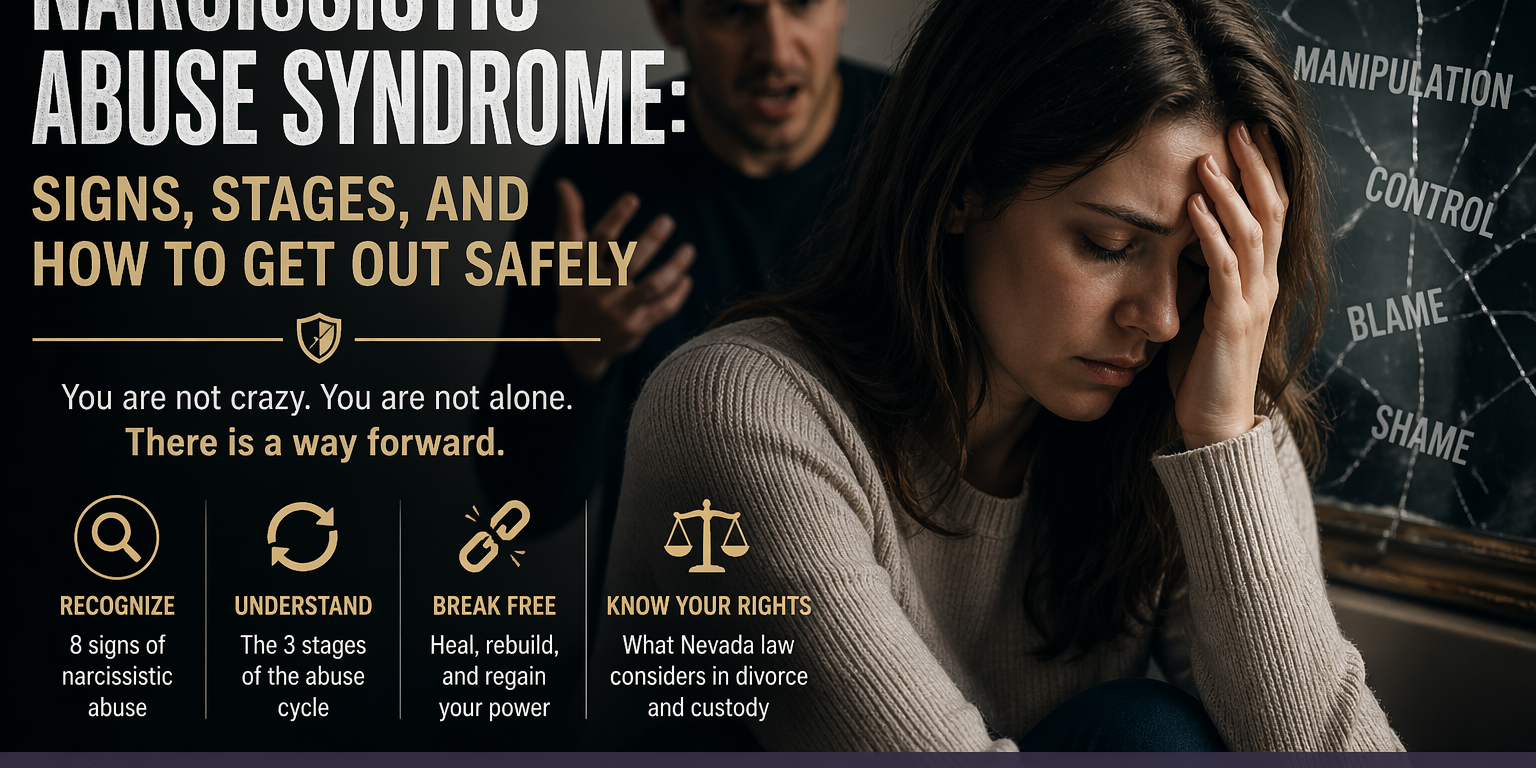
Narcissistic Abuse Syndrome: 8 Signs, 3 Stages & How to Leave
Narcissistic abuse syndrome is a non-clinical term for the cluster of trauma symptoms — hypervigilance, self-doubt, emotional flashbacks, trauma bonding, and loss of identity — that develop after prolonged emotional and psychological abuse by a partner with narcissistic traits or diagnosed narcissistic personality disorder.
Clinical content reviewed by Jeremy Setters, LCSW — Licensed Clinical Social Worker, Nevada License No. 8762-C.
Last updated: August 2026
If you have found your way to this page, something in your relationship has been wrong for a long time. You may not have known what to call it. Friends and therapists may have suggested the word “narcissist” and you weren’t sure it fit — or you were sure it fit and no one believed you. The exhaustion, the self-doubt, the sense that your own reality keeps shifting under your feet: that is what survivors describe as narcissistic abuse syndrome.
This page explains what the term means, the eight signs clinicians and survivors most often describe, the three-stage cycle that keeps people trapped, the clinical concepts behind it (trauma bonding, gaslighting, coercive control), and — specific to Nevada family law — what Clark County courts will and will not consider when a narcissistic spouse is on the other side of a divorce or custody case.
What Is Narcissistic Abuse Syndrome?
Narcissistic abuse syndrome is the informal name for a constellation of symptoms survivors develop after extended exposure to a partner whose behavior is controlling, manipulative, devaluing, and emotionally unsafe. The partner may or may not meet the clinical threshold for narcissistic personality disorder (NPD) — a condition the American Psychiatric Association estimates affects a small fraction of the general population — but their behavior produces the same effect on the person on the receiving end.
The word “syndrome” here is not diagnostic. It is descriptive. It captures the fact that people leaving these relationships tend to present with the same wounds in the same order: hyperarousal, intrusive memories of specific incidents, a collapsed sense of who they are, a body that cannot relax, and a mind that keeps replaying conversations searching for the moment they missed.
Is Narcissistic Abuse Syndrome a Real Clinical Diagnosis?
No. The DSM-5 — the diagnostic manual used by every U.S. clinician — does not list “narcissistic abuse syndrome.” What it does list, and what many survivors of this dynamic meet the criteria for, is complex post-traumatic stress disorder (CPTSD), a recognized trauma response to prolonged interpersonal harm. The symptom profiles overlap substantially.
The reason the informal term persists is that it names something survivors recognize immediately. When a clinician tells someone they have CPTSD, they often nod. When a survivor reads a description of narcissistic abuse syndrome, they cry. Both are accurate. One is diagnostic and the other is lived.
Narcissistic Abuse vs. Emotional Abuse: What’s the Difference?
Narcissistic abuse is a specific form of emotional abuse, not a different category. Emotional abuse is the broader umbrella: any pattern of behavior in a relationship that damages the other person’s sense of self, safety, or autonomy. Narcissistic abuse is emotional abuse driven by a partner whose underlying personality structure is narcissistic — meaning the abuse follows the predictable idealize-devalue-discard cycle, is intertwined with gaslighting and image management, and is rarely accompanied by genuine remorse or change.
The distinction matters clinically because the treatment approaches differ, and it matters legally because documenting the pattern of narcissistic behavior — not just isolated incidents — is what makes the evidence usable in a Clark County custody proceeding.
8 Signs You Are Experiencing Narcissistic Abuse
No single sign is diagnostic on its own. Narcissistic abuse is identified by the pattern — the persistence over months or years, the way the signs cluster together, and the way they escalate when you try to assert yourself or leave.
1. You Are Constantly Apologizing, Even When You Did Nothing Wrong
Survivors describe saying “I’m sorry” dozens of times a day — for existing, for taking up space, for having needs, for reactions that were reasonable. This is not natural conflict aversion. It is the learned response to a partner who punishes you until the apology comes.
2. What Does Gaslighting Do to Your Memory?
This is the signature injury of gaslighting. Your partner tells you conversations did not happen, events unfolded differently than you remember, or your emotional reactions are proof you are “crazy.” Over time, you stop trusting your own recall and start relying on theirs — which is exactly the point.
3. You Walk on Eggshells
You can predict their moods by the sound of the door closing. You rehearse sentences before you say them. You have a running mental list of topics that set them off. This hypervigilance is a trauma response; it is the nervous system trying to prevent the next explosion.
4. Your Social Circle Has Shrunk
Friends drifted away. Family members were labeled “toxic.” Your partner had a reason — always a reason — why each person in your life was not safe, not loyal, or not acceptable. Isolation is not accidental in these relationships. It is the strategy that makes the next stage possible.
5. Why Do You Feel “Crazy” Only When They Are in the Room?
At work, with friends, alone with your thoughts, you function. Introduce your partner into the room and you become the version of yourself they describe — scattered, irrational, “too emotional.” This inconsistency is diagnostic. You are not crazy. You are being cued.
6. You Have Lost Interests, Hobbies, and Parts of Yourself You Used to Like
The book club you quit. The job you didn’t apply for. The friendship you let die. The opinions you stopped voicing. Identity erosion happens slowly in narcissistic relationships, concession by concession, until one day you look up and do not recognize the person in the mirror.
7. You Have Physical Symptoms With No Medical Explanation
Chronic gastrointestinal issues, unexplained fatigue, autoimmune flares, migraines, panic attacks, insomnia. The body keeps score. Prolonged cortisol exposure from living in a threat state has measurable physical consequences, and many survivors report these symptoms resolve after separation.
8. What Is Hoovering in a Narcissistic Relationship?
Hoovering is the pattern where a narcissistic partner “vacuums” you back in the moment you try to leave. You pack a bag, schedule a consultation, or say the word “divorce,” and your partner transforms. Flowers appear. Apologies come. Promises of change are made. The cycle resets. This is not a breakthrough. It is the same pattern preserving itself.
The 3 Stages of Narcissistic Abuse
Survivors rarely recognize the cycle while they are inside it. It is only in retrospect — often with the help of a trauma-informed therapist — that the three stages become visible. The cycle is not random. It repeats, and each repetition tightens the bond and deepens the damage.
Stage 1: Idealization (Love-Bombing)
The relationship begins with an intensity that feels extraordinary. You have never been seen like this. They call you their soulmate within weeks. They move fast — moving in together, meeting families, making long-term plans — at a pace that would feel alarming if it did not feel so good. This phase is not love. It is the hook.
Stage 2: Devaluation
The shift is subtle at first. A sarcastic comment. A sigh of disappointment. A comparison to an ex. Then it accelerates. The qualities they once praised become the qualities they criticize. The person they idealized is now the person who never does anything right. Gaslighting, silent treatment, and rage alternate unpredictably. This is the phase that produces the symptoms.
Stage 3: Discard (or Hoovering)
Eventually there is a rupture. Either they discard you — often abruptly, often for someone new — or you find the strength to leave. If you leave, they rarely let you go cleanly. The hoovering begins: apologies, promises, crises timed for your sympathy, threats disguised as concern. If you return, the cycle restarts at idealization, briefly, before accelerating to devaluation faster than before.
What Is Trauma Bonding?
Trauma bonding is a neurochemical attachment to an abusive partner that develops through intermittent reinforcement — the unpredictable alternation of cruelty and affection. It is recognized by trauma researchers as one of the most powerful forms of behavioral conditioning known, stronger than consistent reward. It is what makes slot machines addictive and what keeps survivors emotionally tethered to partners who have caused serious harm.
Trauma bonding is not love, and it is not weakness. It is biology. Understanding it is often the turning point for survivors who had been blaming themselves for not “just leaving.” You were not weak. Your nervous system was doing what it was conditioned to do, and it can be reconditioned with time and the right support.
What Is Gaslighting?
Gaslighting is a form of psychological manipulation in which one person systematically causes another to doubt their own memory, perception, and judgment. The term comes from the 1944 film Gaslight, in which a husband convinces his wife she is losing her mind in order to control her. In narcissistic relationships, gaslighting is rarely a single dramatic event — it is a slow, steady drip of small contradictions, denials, and reality rewrites that over months or years erode the survivor’s trust in their own mind.
Common gaslighting tactics include flat denial (“That never happened”), minimization (“You’re overreacting”), blame-shifting (“You made me do it”), and weaponized concern (“I’m worried about you — you’re not thinking clearly”). Once you recognize the pattern, you cannot unsee it.
Call (702) 979-1455 to speak with our team, or schedule online. All consultations are confidential.
What Is Coercive Control?
Coercive control is the term increasingly used by clinicians, domestic violence researchers, and family courts to describe the pattern of non-physical but deeply harmful behaviors that characterize narcissistic and other forms of abusive relationships. The concept was developed by sociologist Evan Stark and has reshaped how family courts in the UK, Ireland, and a growing number of U.S. jurisdictions evaluate non-physical domestic abuse.
Coercive control typically includes some combination of:
- Isolation — cutting the partner off from family, friends, and support systems
- Monitoring and surveillance — tracking location, phone, social media, or finances
- Financial control — restricting access to money, sabotaging employment, hiding income
- Gaslighting — undermining the partner’s trust in their own reality
- Rules and micro-regulation — controlling what the partner wears, eats, says, or does
- Threats and intimidation — often subtle, often deniable, always effective
- Using children as leverage — particularly common during and after separation
No single behavior constitutes coercive control. It is the cumulative pattern — and its effect of removing the partner’s autonomy — that defines it. Nevada has not codified coercive control as a standalone legal concept the way some jurisdictions have, but Nevada courts do consider this pattern of behavior when evaluating the “best interest” factors in custody cases and when issuing protective orders under NRS Chapter 33.
How Narcissistic Abuse Affects Children
Children in homes with a narcissistic parent adapt to survive. Some become the golden child, praised and used as proof the parent is healthy. Others become the scapegoat, blamed for the family’s problems. Many oscillate between the two roles. All of them learn that love is conditional, that their feelings are dangerous to express, and that the parent’s mood is their responsibility to manage.
These patterns do not disappear at 18. Adult children of narcissistic parents often present to therapy with anxiety, depression, relationship difficulties, and a profound sense that something is wrong with them — the exact internal state their parent engineered for years. The most protective thing a non-narcissistic parent can often do is leave, with a custody arrangement that limits the other parent’s ability to manipulate the children.
If you are concerned about how your children are being affected, our guide on child custody in Las Vegas explains how Clark County courts approach parenting plans, and what evidence of abusive dynamics can be presented to the court.
Narcissistic Abuse and Nevada Family Law: What Courts Will and Will Not Consider
This section is where the legal side of our firm lives, and it requires candor. Nevada is a no-fault divorce state. You do not need to prove your spouse was abusive, a narcissist, or anything else to end the marriage — “incompatibility” under NRS 125.010 is sufficient, and the process will not put narcissism on trial.
Bottom line for Nevada courts: Clark County judges do not evaluate whether your spouse “is a narcissist.” They evaluate documented patterns of control, conflict, and harm to the children — and those patterns absolutely affect custody, protective orders, and the forensic investigation of financial abuse.
Where narcissistic behavior does matter is in three specific areas: custody, protective orders, and financial recovery when the abuse has been used to hide or dissipate assets. Most clients who come to our firm looking for information about divorcing a narcissist ultimately need help in all three.
Custody: The “Best Interest” Factors That Apply
Under NRS 125C.0035, Nevada courts decide custody based on the best interest of the child. The statute lists twelve factors, and several of them are directly relevant when one parent has engaged in narcissistic abuse or coercive control:
- The level of conflict between the parents
- The ability of the parents to cooperate to meet the needs of the child
- The mental and physical health of the parents
- Whether there has been domestic violence against the child or other person
- Whether either parent has engaged in any act of abduction against the child or any other child
Nevada law does not require bruises for the pattern to matter. NRS 125C.0035 directs courts to consider, among other factors, the level of conflict between the parents, each parent’s ability to cooperate to meet the child’s needs, the mental and physical health of the parents, and any findings of domestic violence, and the statute creates a rebuttable presumption against awarding custody to a parent the court finds has engaged in domestic violence. A documented pattern of coercive control speaks to several of these factors at once.
The challenge remains evidentiary. Narcissistic abuse is rarely physical. There are no bruises, no emergency room records, no police reports. What there is — text messages, recorded incidents, witness accounts, therapist notes — has to be gathered strategically and presented through a lawyer who understands that the goal is not to “prove they’re a narcissist” but to demonstrate a pattern of behavior relevant to the child’s best interest.
Protective Orders Under NRS 33
If your spouse’s behavior has escalated to threats, stalking, or physical harm, Nevada’s NRS Chapter 33 provides for Temporary Protective Orders (TPOs) and Extended Protective Orders. These can include stay-away provisions, exclusive use of the marital residence, and temporary custody arrangements. They are filed in the Eighth Judicial District Court’s Family Division, and Gastelum Attorneys regularly represents clients in these matters.
A protective order is a serious tool, and it carries weight in subsequent custody proceedings. It is also not a tool to use tactically — courts see through that. If you are in actual danger, it is the right step. If you are not, there are other approaches.
Financial Abuse and Hidden Assets
Nevada is a community property state under NRS Chapter 123. Assets and income acquired during the marriage are owned equally, regardless of whose name is on the title. Narcissistic spouses often engage in what family law practitioners call financial infidelity: hidden accounts, diverted income, cash withdrawals, undisclosed business interests, cryptocurrency, real estate held in the name of a family member or shell entity.
When we suspect hidden assets, the path forward includes formal discovery, subpoenas to financial institutions, and — in substantial cases — a forensic accountant retained specifically to trace money. This work is expensive, but in high-conflict divorces with meaningful assets, it often recovers many multiples of what it costs.
Parallel Parenting, Not Co-Parenting
The conventional wisdom that divorced parents should “co-parent” assumes two reasonable adults. With a narcissistic ex, co-parenting is often impossible — and attempting it keeps you exposed to continued manipulation. The alternative is parallel parenting: a highly structured custody arrangement in which parents have minimal direct contact, communicate only in writing through monitored platforms (OurFamilyWizard, TalkingParents), and raise the children on separate tracks. Courts in Clark County are increasingly willing to order parallel parenting arrangements when the evidence supports it.
Can You Heal From Narcissistic Abuse?
Yes. The clinical literature on trauma recovery is genuinely encouraging. Many survivors who engage in trauma-focused treatment — typically some combination of CBT, EMDR, Internal Family Systems therapy, and somatic approaches — report meaningful symptom reduction over the first one to two years. The body’s stress response re-regulates. Sleep returns. Trust in one’s own perception comes back, slowly. People fall in love again, and recognize love as something quieter and steadier than they had been taught.
What Is the Gray Rock Method?
The gray rock method is a widely used coping technique for situations where contact with a narcissistic person is unavoidable — court appearances, custody exchanges, shared parenting communications. The principle is simple: present as flat, uninteresting, and emotionally unreactive. A gray rock. It was popularized by a 2012 pseudonymous essay rather than developed in clinical research; it is a coping tool, not a validated treatment.
Narcissists are energized by emotional reactions, both positive and negative. Withholding reaction denies them the “supply” the behavior is designed to extract. Over time, many lose interest and move on to easier targets. Gray rock is not a permanent solution, and it is not appropriate in all situations (including when physical safety is at risk), but in co-parenting and court-adjacent contexts it is often the difference between being retraumatized and being functional.
No Contact and Low Contact
The gold standard for recovery, when safe and logistically possible, is No Contact: no calls, no texts, no social media, no mutual friends passing information. When children are shared, this becomes Low Contact — communication only about the children, in writing, through a monitored platform. Both approaches deny the narcissistic ex access to the emotional supply they used to depend on, and both protect the survivor’s healing process from being interrupted.
Trauma-Informed Therapy
Trauma-informed therapy is not the same as general couples counseling. If you are leaving a narcissistic relationship, find a clinician who specializes in narcissistic abuse recovery, CPTSD, or trauma-focused treatment. Couples counseling with an active narcissist is generally counterproductive and can make things worse — a point we return to in the FAQ below.
Steps to Take Before Filing for Divorce
If you have decided the relationship is over, there are things to do before announcing it. Narcissistic partners often react to the word “divorce” by accelerating whatever they have been doing — hiding money, isolating children, making preemptive allegations. Preparation matters.
- Document the financial picture. Make copies of the last three years of tax returns, bank statements, investment accounts, retirement accounts, credit card statements, and property records. Store them somewhere your spouse cannot access.
- Open accounts in your name only. A checking account at a different bank, a credit card they do not know about, and a post office box if your home mail is being screened.
- Preserve evidence carefully. Screenshot abusive texts. Save voicemails. Nevada’s recording rules are split. You may record an in-person conversation you are part of with only your own consent under NRS 200.650. Phone calls are different: NRS 200.620, as interpreted by the Nevada Supreme Court in Lane v. Allstate, requires the consent of every person on the call, and violating it is a felony. Texts, emails, and voicemails your spouse sends you are safe to preserve. Before recording anything, talk to an attorney.
- Build a safety plan if abuse has been physical or is escalating. The National Domestic Violence Hotline (1-800-799-7233) can help with planning. In Nevada, SafeNest provides local shelter, advocacy, and 24/7 crisis support.
- Consult a family law attorney in confidence. A consultation is privileged — your spouse will not know you had it. You can gather information, understand your options, and build a strategy without committing to file until you are ready.
Speaking With Gastelum Attorneys
If you are in a relationship that matches what is described on this page — or you have left one and need legal help moving forward — our team has handled more than 5,000 family law cases in Clark County since 2018, many of them high-conflict matters involving narcissistic spouses, hidden assets, and contested custody.
Call (702) 979-1455 for a confidential consultation, or schedule online. Services available in English and Spanish.
Frequently Asked Questions
Is narcissistic abuse syndrome recognized by courts?
Courts do not recognize “narcissistic abuse syndrome” as a formal legal or clinical term, and no Nevada judge will decide a case based on that label alone. What courts do recognize is evidence of specific behaviors — coercive control, domestic violence, financial dissipation, interference with the other parent’s relationship with the child — and those behaviors are what matter under NRS 125C.0035 and related statutes.
How do I divorce a narcissist in Nevada?
Divorcing a narcissist in Nevada follows the same no-fault procedure as any other divorce, but the strategy is different. Expect your spouse to prolong the process, hide assets, make preemptive allegations, and use the children as leverage. Document everything before you file, open separate financial accounts, preserve communications, retain an attorney experienced in high-conflict divorce, and plan for a longer and more contested process than a typical dissolution. Uncontested divorce with a narcissistic partner is rare.
What is trauma bonding and why does it make it so hard to leave?
Trauma bonding is a neurochemical attachment that develops through intermittent reinforcement — the unpredictable alternation of cruelty and affection that characterizes narcissistic relationships. It is one of the strongest forms of behavioral conditioning known, which is why survivors often feel inexplicably unable to leave even when they intellectually understand the relationship is harmful. Recognizing trauma bonding as a biological phenomenon, rather than a personal failing, is often a turning point in recovery.
Can narcissistic abuse cause PTSD or CPTSD?
Yes. Prolonged interpersonal abuse is one of the recognized causes of complex post-traumatic stress disorder (CPTSD), a clinical condition included in the ICD-11 diagnostic system. Many survivors of narcissistic abuse meet the criteria for CPTSD or, in cases involving single traumatic events (for example, a violent incident), PTSD. If you suspect this applies to you, a trauma-informed clinician can evaluate and recommend treatment — CBT, EMDR, and somatic therapies all have evidence of benefit.
What is the difference between narcissistic abuse and emotional abuse?
Narcissistic abuse is a specific form of emotional abuse. Emotional abuse is the broader category — any pattern of behavior in a relationship that damages the other person’s sense of self, safety, or autonomy. Narcissistic abuse specifically follows the idealize-devalue-discard cycle, is intertwined with gaslighting and image management, and is driven by a partner whose underlying personality structure is narcissistic. All narcissistic abuse is emotional abuse, but not all emotional abuse is narcissistic abuse.
What is coercive control, and is it illegal in Nevada?
Coercive control is the term used to describe the pattern of non-physical but deeply harmful behaviors — isolation, surveillance, financial control, gaslighting, intimidation — that characterize abusive relationships. Nevada has not codified coercive control as a standalone criminal offense, but Nevada family courts do consider coercive control as part of the best-interest analysis under NRS 125C.0035 and when issuing protective orders under NRS Chapter 33. The pattern matters legally, even without physical violence.
Can I get sole custody if my spouse is a narcissist?
“Narcissist” alone is not a legal standard. What courts evaluate is whether joint custody is in the best interest of the child. If the evidence shows domestic violence, manipulation of the children, serious mental health concerns affecting parenting, or an inability to cooperate at a baseline level, primary physical custody or — in more severe cases — sole legal custody may be appropriate. The evidentiary burden is substantial and the case has to be built carefully.
Should I go to marriage counseling with a suspected narcissist?
Clinical consensus is generally no. Couples counseling assumes two parties willing to examine their contributions to the dynamic. With an active narcissist, the therapy session often becomes another venue for manipulation — and what you say can be weaponized later. Individual therapy for the non-narcissistic partner is a far safer starting point. If you are considering divorce, our article on whether you are ready to divorce may help clarify where you stand.
How is this different from walkaway wife syndrome or miserable husband syndrome?
The other syndromes in our cluster describe marriages dying from neglect, exhaustion, and emotional disengagement. Narcissistic abuse is active, not passive. It is characterized by a power imbalance, manipulation, and psychological harm inflicted by one partner on the other. If you are in a marriage with slow emotional drift, our pages on miserable husband syndrome and walkaway wife syndrome may describe your situation more accurately.
Does Nevada being a no-fault state mean the abuse does not matter?
Abuse does not affect whether the divorce will be granted — it will be, on no-fault grounds, regardless. But abuse absolutely affects custody, protective orders, and the forensic investigation of financial abuse. No-fault ends the marriage; it does not end the legal consequences of what happened inside it.
New Beginnings, Brighter Tomorrows
The people who find this page are usually in the late stages of deciding. You have already read the articles. You have tried the counseling. You have told yourself for years that it would get better. It has not, and something in you is starting to know that it will not.
Leaving a narcissistic partner is the hardest thing most survivors ever do, and also the thing they later describe as the beginning of their own lives. Nevada law cannot undo what happened to you, but it can protect your children, recover what is financially yours, and give you the structural separation you need to heal. That is work our firm does every week.
When you are ready to talk, we are here. (702) 979-1455.