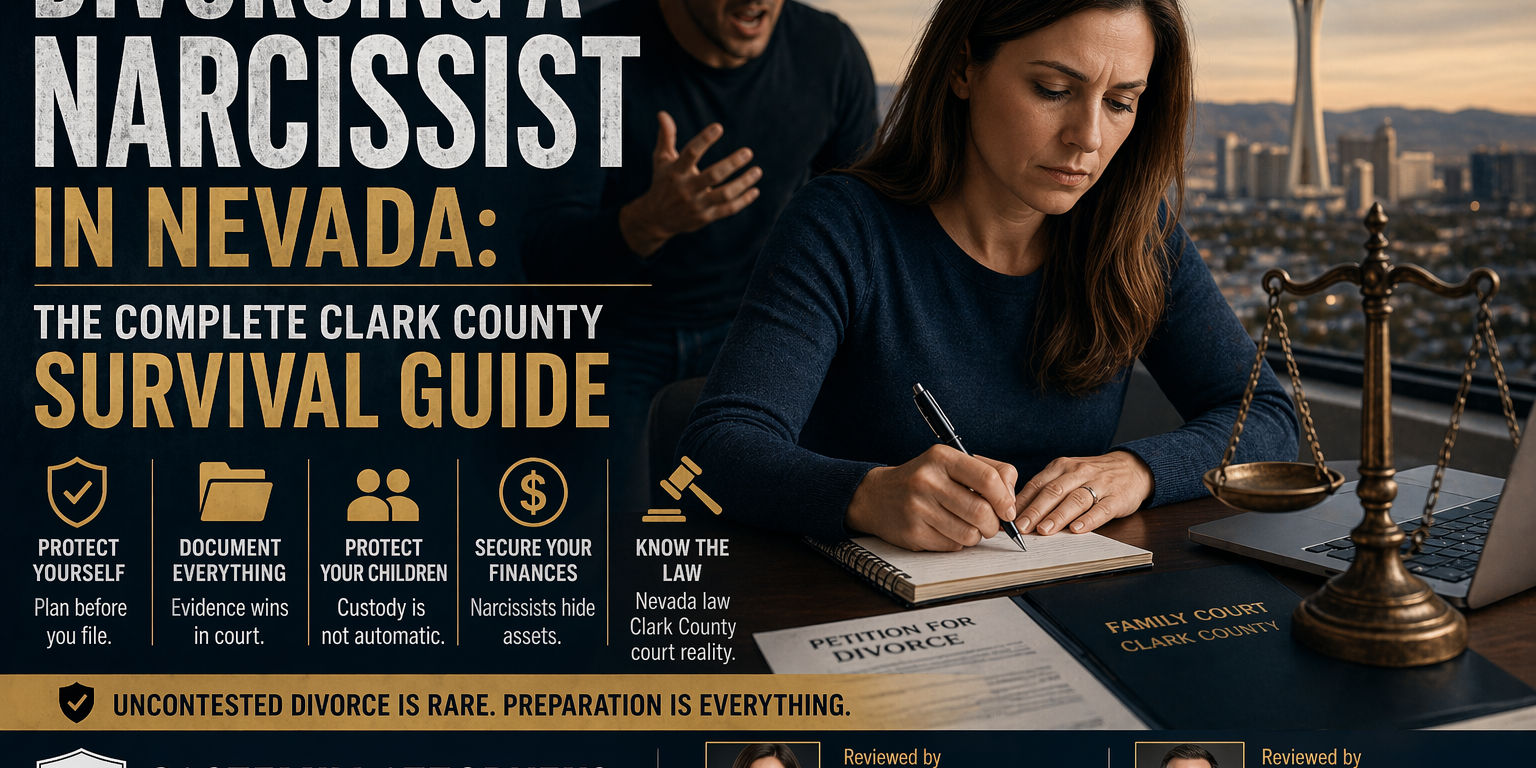
Divorcing a Narcissist in Nevada: The Complete Clark County Survival Guide
Divorcing a narcissist in Nevada follows the same no-fault procedure as any other divorce under NRS 125.010, but the strategy, timeline, evidence work, and custody approach are fundamentally different — and planning for the predictable manipulation tactics before you file is what separates survivors who emerge with protection from survivors who emerge with debt, lost custody, and years of additional trauma.
Clinical content (trauma response, coercive control patterns, psychological tactics during divorce) reviewed by Jeremy Setters, LCSW — Licensed Clinical Social Worker, Nevada License No. 8762-C.
This page is informational and does not constitute legal advice, therapy, or a clinical diagnosis.
Last updated: April 2026
If you are here, you have almost certainly already read the psychology pages. You know the pattern. You have identified the idealize-devalue-discard cycle in your own marriage. You have done the hard internal work of recognizing that you are not crazy, not exaggerating, and not alone. What you need now is not more validation. You need a plan.
This page is that plan, from the perspective of a Las Vegas family law firm that handles these cases in Clark County Family Court every week. It covers what to expect before you file, the seven predictable moves your spouse will make once the divorce is underway, the specific Nevada statutes that will govern your case, what Clark County Family Court actually looks like in practice, and the operational steps that separate a well-prepared filing from a reactive one.
If you have not yet read our companion page on the psychology of narcissistic abuse syndrome, start there. This page assumes you already understand what you are dealing with. What follows is how Nevada law handles it.
Why Divorcing a Narcissist Is Different
A standard divorce, even a contested one, involves two people whose interests diverge but whose underlying motivation is the same: end the marriage, divide what was shared, move on. Both sides want the case closed. Both sides want to minimize cost. Both sides eventually want to live as separated adults.
A divorce with a narcissistic spouse rarely has that symmetry. Your spouse’s motivation is not the same as yours. For someone with narcissistic traits, divorce registers as a profound injury to self-image — a public declaration that they were not chosen, not adequate, not in control. The divorce itself becomes a venue to prove otherwise, regardless of cost to them, to you, or to the children.
This produces predictable distortions in the legal process:
- Settlement becomes harder, not easier. Reasonable offers are rejected not because they are unfair but because accepting them would feel like losing.
- Every motion becomes a battle. Routine procedural matters that should take a single email get litigated.
- Children are weaponized. Custody becomes less about parenting and more about denying you what you want.
- The truth becomes negotiable. Facts that were established at the start of the case get denied by the end. Documents disappear. Affidavits contradict prior testimony.
- The timeline extends. Delays that would serve no strategic purpose for a rational party serve a narcissistic party perfectly: they prolong control, deplete your resources, and increase your willingness to settle for less.
The 4 Stages a Narcissist Goes Through During Divorce
Narcissists in divorce proceedings follow predictable behavioral stages. Understanding these stages helps you prepare emotionally and legally for what comes next.
Stage 1: Denial and charm. In the early stages, a narcissistic spouse may refuse to believe the divorce is happening. They may alternate between pleading for reconciliation and threatening consequences. In court, they present as reasonable and cooperative — the “good spouse” who was blindsided.
Stage 2: Escalation and control. Once reality sets in, the narcissist shifts to aggressive tactics. This is when financial accounts get drained, false allegations get filed, and the children become pawns. Court filings increase dramatically. Every communication becomes a potential exhibit, and the narcissist carefully crafts messages designed to provoke an emotional response they can use against you.
Stage 3: Litigation as punishment. For narcissists, the divorce process itself becomes the weapon. They reject reasonable settlement offers not because the terms are unfair but because settling means losing control. They may fire attorneys who advise compromise and hire more aggressive replacements. Legal fees escalate for both parties, which the narcissist views as an acceptable cost of maintaining dominance.
Stage 4: Post-decree conflict. Even after the divorce is finalized, narcissists frequently return to court with modification requests, contempt motions, or new allegations. A well-drafted decree that anticipates these behaviors — with specific, enforceable terms and built-in consequences for violations — significantly reduces post-decree litigation.
None of this is legal strategy — it is pathology surfacing through the legal process. Understanding the difference is the first thing a Clark County attorney experienced in these cases will teach you. You cannot out-negotiate a person whose objective is not agreement. You can only out-prepare them.
Is My Husband a Narcissist? Signs to Watch For
Recognizing narcissistic behavior patterns before and during divorce proceedings is important because it changes how you should approach legal strategy. The following patterns frequently appear in divorce cases involving narcissistic spouses.
During the marriage:
- Your spouse controlled all financial decisions and restricted your access to accounts.
- They isolated you from family and friends.
- They responded to disagreements with rage, silent treatment, or blame-shifting.
- They showed little genuine interest in the children’s emotional needs beyond how the children reflected on them publicly.
- They gaslit you — denying events that happened, rewriting history, and making you question your own memory and judgment.
During divorce proceedings:
- They refuse to provide financial discovery or provide incomplete and misleading responses.
- They file frivolous motions to increase your legal costs.
- They make false allegations to Child Protective Services or law enforcement.
- They tell the children damaging information about you or the divorce.
- They charm court personnel, mediators, and evaluators while behaving abusively in private.
- They violate court orders and then blame you for the violation.
If these patterns describe your situation, the strategies in this guide apply directly to your case. It is not necessary to have a clinical diagnosis of NPD for these legal protections to apply — the court evaluates behavior, not diagnoses.
7 Predictable Moves a Narcissistic Spouse Will Make During Divorce
These behaviors are so consistent across cases that family law practitioners treat them as baseline expectations rather than surprises. Anticipating them is what allows strategic preparation. You are not paranoid for expecting these moves. You would be unprepared if you did not.
1. They Will File First (or Sabotage Your Filing)
Narcissists treat divorce as a contest. Filing first gives them the narrative — they become the party who left, not the party who was left. If you announce your intention to divorce without being ready to file, expect them to beat you to the courthouse, often with a petition containing allegations designed to reframe the marriage. The strategic response: do not announce. File first if possible, or file simultaneously with the announcement.
2. They Will Hide Assets
Expect some combination of: sudden cash withdrawals, unexplained “business losses” before filing, cryptocurrency moved to wallets you do not know exist, property transferred to a family member, undisclosed retirement contributions, and loans to friends that are really asset parking. This is so common in high-conflict Nevada divorces that forensic accounting is often the difference between recovering what is rightfully yours and leaving tens or hundreds of thousands of dollars on the table. More on this below under financial discovery.
3. They Will Make False or Exaggerated Allegations
Allegations of substance abuse, mental health instability, parental unfitness, or — in the most severe cases — domestic violence or child abuse are common strategic moves. The goal is not truth; it is leverage. A protective order against you, even a temporary one later dismissed, affects custody, housing, and the narrative the judge hears first. Preemptive documentation of your actual conduct and mental state is the defense.
4. They Will Use the Children as Leverage
Expect some combination of: refusing to honor temporary custody orders, coaching the children about what to say to evaluators, sudden interest in parenting after years of disengagement, alienation tactics framed as concern, and using pickup/dropoff as opportunities for conflict that can be reported to the court. Parallel parenting arrangements and monitored communication platforms (OurFamilyWizard, TalkingParents) exist because of these behaviors.
5. They Will Drag Out Proceedings
Delay favors the party with narcissistic motivation. Every continuance, every refused settlement, every new motion prolongs their control and depletes your legal budget. Experienced high-conflict attorneys plan for this from day one — with litigation budgets, sequencing strategies, and willingness to seek attorney’s fees under NRS 125.150(3) when delay is being used as harassment.
6. They Will Hoover
Hoovering during divorce looks different from hoovering during the relationship. The apologies come dressed as reasonableness: “I don’t want this to hurt the kids,” “Let’s just settle this between us without lawyers,” “I’ve changed — can we try again?” These approaches are almost never genuine at the divorce stage. They are attempts to disarm your legal strategy, get you to drop an attorney, or produce a reconciliation attempt they can later weaponize as evidence you are unstable or indecisive.
7. They Will Deploy “Flying Monkeys”
In narcissistic dynamics, flying monkeys are third parties — mutual friends, in-laws, sometimes the narcissist’s own attorney — recruited to deliver messages, apply pressure, or carry surveillance information back. Expect contact from people you did not expect to hear from during the divorce. Expect well-meaning family members to pass along information. Limit what you share verbally with anyone not covered by attorney-client privilege.
Call (702) 979-1455 or schedule online. All consultations are confidential.
How to Prepare Before Filing in Nevada
The single biggest strategic lever in divorcing a narcissist is what you do before you file. Once the petition is served, the dynamics change — your spouse is on notice, defensive, and actively calculating. Everything that is harder to do after service is easier to do now, in silence.
Financial Documentation
Gather, copy, and store outside the home:
- The last three years of federal tax returns (all schedules and attachments)
- All W-2s, 1099s, K-1s, and income statements for both spouses
- Bank statements (checking, savings) for all known accounts, last 24 months minimum
- Investment account statements (brokerage, retirement, 401(k), IRA)
- Credit card statements, last 24 months
- Mortgage documents, deeds, and property tax records for all real estate
- Business records (if either spouse owns a business): P&Ls, tax filings, partnership agreements
- Vehicle titles and registrations
- Life insurance policies and beneficiary designations
- Recent paystubs for both spouses
If documents are stored digitally and your spouse has access to the same cloud accounts, download local copies to a device and storage location they do not know exists. A password-protected external drive kept with a trusted friend or family member is a common solution.
Separate Financial Infrastructure
Before filing, open:
- A checking account at a bank your spouse does not use, with paper statements sent to an address they cannot access (a P.O. box is the standard solution)
- A credit card in your name only
- A new email address your spouse does not know exists, for attorney communication
- If safety concerns exist, a prepaid cell phone for communicating with your attorney and safety contacts
Evidence Preservation
Nevada is a one-party consent state for audio recording under NRS 200.650, which means you may legally record conversations you are a party to without the other party’s knowledge. However — and this is where consulting an attorney first matters — Clark County family court judges scrutinize such recordings carefully. Recordings made strategically to create evidence, rather than to document genuine safety concerns, can backfire.
What is almost always safe and useful to preserve:
- Text messages and emails (screenshot and back up to an external location)
- Voicemails containing threats or manipulation
- Social media posts or direct messages
- Photographs of property damage, injuries, or documentation of events
- A contemporaneous written log of incidents with dates, times, witnesses, and specific behaviors
Confidential Attorney Consultation
An attorney consultation is covered by attorney-client privilege from the moment it begins. Your spouse will not learn about it unless you tell them. You can consult multiple attorneys before deciding who to retain, and you can gather information without committing to file. This is the standard practice for high-conflict divorces, and no reputable Nevada family law attorney will pressure you to file before you are ready.
The Nevada Legal Framework: What Governs Your Case
Bottom line for Nevada courts: Your spouse’s narcissism will not be on trial. What will be evaluated is their documented behavior — how they parent, how they handle finances, how they treat the children, and whether they comply with court orders. Preparing evidence of behavior is the legal equivalent of preparing evidence of narcissism.
No-Fault Divorce Under NRS 125.010
Nevada is a no-fault state. Under NRS 125.010, you may file based on incompatibility without alleging fault, misconduct, or abuse. This has two important consequences for divorcing a narcissist:
- Your spouse cannot block the divorce. They can delay it, complicate it, and contest custody and property, but they cannot prevent the court from ultimately granting dissolution.
- Narcissism itself will not be litigated as “fault.” The court will not make a finding that your spouse is or is not a narcissist. What the court will evaluate is specific behavior relevant to custody, support, and property division.
Residency Requirement Under NRS 125.020
You must be a Nevada resident for at least six weeks before filing under NRS 125.020. Residency is established by physical presence and intent to remain, and can be corroborated by a third-party affidavit (the “Resident Witness Affidavit”). For most Las Vegas residents, this is not an obstacle; for military families or recent transplants, timing the filing around the residency window is a strategic consideration.
Custody Under NRS 125C.0035 and Martinez v. Martinez (2024)
Custody is where narcissistic behavior matters most legally. Nevada courts decide custody based on the best interest of the child under NRS 125C.0035, which lists twelve factors. Several are directly relevant in narcissistic abuse cases:
- The level of conflict between the parents
- The ability of the parents to cooperate to meet the needs of the child
- The mental and physical health of the parents
- Whether there has been domestic violence against the child or another person
- Whether either parent has engaged in abduction against the child or another child
The 2024 Nevada Supreme Court decision in Martinez v. Martinez clarified that documented patterns of controlling and manipulative behavior by one parent are directly relevant to the best-interest analysis, even in the absence of physical violence. For survivors of narcissistic abuse, this is the legal doctrine that makes the pattern itself cognizable by the court — not just isolated incidents. Building a case that demonstrates pattern, not just episodes, is how modern Clark County custody litigation against a narcissistic parent is won.
Community Property Under NRS Chapter 123
Nevada is a community property state under NRS Chapter 123. All property and income acquired during the marriage is presumed owned equally by both spouses, regardless of whose name is on the account or title. The classic narcissistic spouse response — “it’s in my name, it’s mine” — has no legal basis in Nevada. The name on the deed or the account is largely irrelevant; what matters is when and how the asset was acquired.
Spousal Support Under NRS 125.150
Alimony in Nevada is governed by NRS 125.150, which lists factors including the financial condition of each spouse, their earning capacities, the contribution of each to the marital property, the duration of the marriage, and the standard of living during the marriage. Nevada does not use a fixed formula the way child support does — spousal support is discretionary, argued, and awarded case-by-case. For survivors whose narcissistic spouses engaged in financial abuse or sabotaged their careers, this discretion can work in your favor with the right evidentiary presentation.
Protective Orders Under NRS Chapter 33
If your spouse’s behavior has escalated to threats, stalking, harassment, or physical harm, NRS Chapter 33 provides for Temporary Protective Orders (TPOs) and Extended Protective Orders. These orders can include stay-away provisions, exclusive use of the marital residence, and temporary custody arrangements. They carry significant weight in subsequent custody proceedings.
A critical caution: protective orders are not tactical tools. Clark County judges see patterns of protective orders filed strategically during divorces and discount them accordingly. If you genuinely need the protection, it is the right step and the evidence will support it. If you are considering one as leverage, the risk of the court viewing it as manipulation is substantial.
What to Expect in Clark County Family Court
The Eighth Judicial District Court, Family Division, handles all Clark County divorce cases from the Regional Justice Center at 200 Lewis Avenue in downtown Las Vegas. Understanding how this court actually operates, day-to-day, is something most general guides will not give you.
Judicial Assignment and Judge Preferences
Your case will be assigned to one of the Family Division judges. Each judge has documented preferences regarding motion practice, settlement conferences, evidentiary standards, and tolerance for high-conflict behavior. An attorney who practices in Clark County regularly knows which judges take a hard line on parental alienation, which are more skeptical of protective orders filed during divorce, and which prefer parenting coordinators over ongoing litigation. This is not insider knowledge — it is the practical working knowledge every local family law attorney accumulates, and it matters enormously in a case where tactical decisions depend on how the specific judge handles conflict.
Custody Evaluations and Guardian Ad Litem Appointments
In high-conflict custody cases, the court may order a custody evaluation by a licensed mental health professional, or appoint a Guardian Ad Litem (GAL) to represent the children’s interests. Both are substantial financial commitments — evaluations typically run $5,000 to $15,000 or more, GALs bill hourly — and both become their own battlefield in narcissistic divorce cases.
Narcissistic spouses are often initially impressive to evaluators. They present well, speak articulately about the children, and can produce the appearance of a healthy parent for an hour at a time. The damage usually surfaces when the evaluator interviews collateral witnesses (teachers, therapists, extended family) and when they observe the narcissistic parent with the children in unstructured settings. Preparing for a custody evaluation — with your attorney’s guidance — is its own strategic exercise.
Parallel Parenting Orders
For high-conflict post-divorce custody, Clark County judges are increasingly willing to order parallel parenting rather than traditional co-parenting. Parallel parenting means:
- Minimal direct contact between parents
- Communication only in writing through a monitored platform (OurFamilyWizard is the Clark County standard)
- Exchanges at neutral public locations or through third parties
- Each parent making day-to-day decisions during their own parenting time without consultation
- Major decisions (medical, educational, religious) either assigned to one parent or decided by a parenting coordinator
Parallel parenting is not the default — judges still prefer cooperative co-parenting where possible — but it is the appropriate framework when one parent’s behavior makes cooperation impossible. Building the evidentiary record that justifies a parallel parenting order is part of what your attorney will plan for from the beginning.
Timeline Realities
Uncontested Nevada divorces can close in six to eight weeks. Divorcing a narcissist is rarely uncontested. Realistic expectations for contested Clark County cases with narcissistic dynamics:
- Temporary orders hearing: 30 to 90 days after filing
- Discovery and disclosure: 4 to 8 months
- Settlement conferences: often multiple, spread across 6 to 12 months
- Trial (if no settlement): 12 to 24 months from filing, sometimes longer
- Post-decree modifications: common and ongoing, sometimes for years
The right strategic question is not “how do I make this faster.” It is “how do I make this sustainable” — emotionally, financially, and practically — across a timeline that will likely be longer than you want.
Hidden Assets and Forensic Financial Discovery
Financial abuse is one of the most common — and most recoverable — forms of narcissistic behavior during divorce. When assets are being hidden, the legal tools exist to find them, but they have to be deployed strategically and paid for upfront.
Formal Discovery
Once the case is filed, both parties are required to exchange sworn Financial Disclosure Forms under Nevada Rule of Civil Procedure 16.2. Beyond the required disclosure, formal discovery tools include interrogatories (written questions under oath), requests for production of documents, and depositions. An experienced attorney will tailor discovery specifically to the suspected pattern of asset hiding — cryptocurrency wallets, business accounts, real estate transfers to family members, loans that are really transfers.
Third-Party Subpoenas
Subpoenas can be issued to banks, brokerages, employers, and business partners to produce records directly rather than relying on your spouse’s disclosure. This is often where hidden assets first appear in the case — the records the bank produces do not match the records your spouse claimed existed.
Forensic Accountants
For cases with meaningful assets — business ownership, complex investment portfolios, real estate holdings, cryptocurrency — a forensic accountant retained by your legal team can trace funds, identify discrepancies, and testify as an expert witness. Forensic work is expensive, typically $5,000 to $50,000 or more depending on complexity, but in high-asset divorces it routinely recovers multiples of its cost. The decision to retain a forensic accountant is case-specific and made in consultation with your attorney after initial disclosure.
Dissipation Claims
When a spouse spends marital funds on an affair, gambling, or other non-marital purposes in the period leading up to divorce, Nevada courts can treat this as dissipation and credit those amounts back to the non-dissipating spouse in the property division. This is a common remedy in narcissistic divorce cases where the spouse has been living a parallel life at marital expense.
Working With Your Attorney: What to Bring and What to Do
What to Bring to the First Consultation
- A written timeline of the marriage with key events, dated
- A list of assets, debts, and accounts (even partial is useful)
- Copies of key documents: recent tax returns, marriage certificate, any prior agreements (prenup, postnup)
- A written list of your specific concerns and goals (custody, support, property, safety)
- Any evidence you have already preserved: text screenshots, emails, the incident log
- Questions about fees, strategy, and timeline
What NOT to Do During the Divorce
- Do not post on social media about the divorce, your spouse, or the case. Everything is discoverable and will be used against you.
- Do not engage in text arguments with your spouse. Every message is a potential exhibit. When in doubt, do not respond; loop your attorney in.
- Do not make major financial decisions without your attorney’s input — selling property, moving money, changing beneficiaries, or making large purchases can all have legal consequences during a divorce.
- Do not let the children hear you discuss the case or your spouse in negative terms. This can become evidence of parental alienation.
- Do not violate court orders even when your spouse does. The court will view your compliance and their non-compliance as evidence; your reactive non-compliance neutralizes that advantage.
- Do not reconcile without consulting your attorney first. Hoovering attempts are common. Reconciliation that later fails is legally complex and can affect your case.
Speaking With Gastelum Attorneys
Our firm has handled more than 5,000 family law cases in Clark County since 2018, many of them high-conflict matters involving narcissistic spouses, hidden assets, contested custody, and parallel parenting orders. We know the local judges, the evaluators, the GALs, and the procedural realities of the Eighth Judicial District Court’s Family Division.
Call (702) 979-1455 for a confidential consultation, or schedule online. Services available in English and Spanish.
Frequently Asked Questions
How long does it take to divorce a narcissist in Nevada?
Uncontested Nevada divorces can close in six to eight weeks, but uncontested divorces with a narcissistic partner are rare. Realistic expectations for contested cases in Clark County range from 12 to 24 months from filing to final decree, sometimes longer if custody is heavily litigated or a trial is required. Post-decree modifications are also common in these cases, meaning the legal relationship may continue for years after the divorce itself is finalized.
How much does it cost to divorce a narcissist?
Costs vary widely based on contested issues. Simple contested divorces may run $10,000 to $30,000 per spouse. High-conflict narcissistic divorces involving custody evaluations, forensic accounting, and multiple motions routinely run $50,000 to $150,000 or more per spouse. Budgeting for a longer and more expensive process than a typical divorce is realistic planning, not pessimism. Attorney’s fees can sometimes be recovered from the other party under NRS 125.150(3) where misconduct or bad-faith litigation is shown.
Will my spouse find out I consulted an attorney?
No. Attorney-client privilege applies from the moment a consultation begins, whether or not you retain the attorney. Your spouse will not be notified that you consulted, and the attorney cannot disclose what you discussed. You may consult multiple attorneys to find the right fit before deciding.
Should I leave the house before filing?
This is a case-specific question that should be answered with an attorney. Leaving can affect temporary custody arrangements, use of the marital residence, and your negotiating position. In safety emergencies, leaving is the right call without question. In non-emergency situations, the decision is tactical and should not be made based on general advice online.
Can I record my spouse to prove they are a narcissist?
Nevada is a one-party consent state under NRS 200.650, so you can legally record conversations you are a party to without the other party’s knowledge. But Clark County family court judges scrutinize such recordings carefully, and recordings made strategically to create evidence often backfire. Consult an attorney before using any recording strategically, and never record conversations you are not a party to — that is a criminal offense in Nevada.
How do I win a custody battle against a narcissist?
“Winning” in custody terms means persuading the court that the child’s best interest under NRS 125C.0035 is served by an arrangement that protects the child from the narcissistic parent’s behavior. The evidentiary burden is substantial. Success typically requires: a clear documented pattern of the spouse’s behavior over time, collateral witnesses (teachers, therapists, extended family), expert evaluation evidence, and consistent compliance with your own obligations so the court sees a stark behavioral contrast. In more severe cases involving domestic violence, primary or sole custody is achievable. In less severe cases, joint legal custody with primary physical custody to the non-narcissistic parent and structured parallel parenting is a more realistic outcome.
What if my spouse hides assets during the divorce?
Nevada’s community property rules combined with formal discovery and third-party subpoenas give the court real tools to find hidden assets. For high-asset cases, a forensic accountant retained as an expert can trace funds, identify discrepancies, and testify to the court. Hiding assets, when discovered, typically results in the hiding spouse being awarded less than half of the recovered assets and potentially being ordered to pay the other spouse’s attorney and expert fees. Asset concealment is a serious strategic mistake for the spouse who attempts it.
Does Nevada’s no-fault divorce law mean my spouse’s abuse does not matter?
No-fault means you do not have to prove fault to get the divorce granted — you will get the divorce regardless. But fault-adjacent evidence (domestic violence, coercive control, financial abuse, parental behavior) is directly relevant to custody under NRS 125C.0035, to spousal support discretion under NRS 125.150, and to protective orders under NRS Chapter 33. No-fault ends the marriage; it does not end the legal consequences of how the marriage was conducted.
Can my narcissistic spouse force me into mediation?
Clark County family court may order mediation on specific issues, but mediation with a narcissistic spouse is often counterproductive and sometimes harmful. Mediators are not therapists and are not trained to identify manipulation. If mediation is ordered, your attorney can request structural protections: shuttle mediation (where you are in separate rooms), attorney participation in sessions, and withdrawal if the process becomes abusive. Discuss specific concerns with your attorney before the first mediation session.
What is parallel parenting and how do I get it ordered?
Parallel parenting is a court-ordered custody framework where parents have minimal direct contact, communicate only in writing through monitored platforms (OurFamilyWizard is the Clark County standard), and raise the children on separate tracks. Clark County judges order parallel parenting when the evidence shows that traditional co-parenting is impossible due to one parent’s behavior. Getting it ordered requires documented evidence — communication records showing abuse during attempted co-parenting, evidence of interference or alienation, testimony from collateral witnesses — that is built strategically with your attorney during the contested custody phase of the case.
Related Reading in Our Narcissistic Abuse Cluster
- Narcissistic Abuse Syndrome: Signs, Stages, and How to Leave Safely — the psychological pattern behind the divorce
- Miserable Husband Syndrome — when the dynamic is passive rather than active
- Walkaway Wife Syndrome — the slow-build disengagement pattern
- Child Custody in Las Vegas — how Clark County courts handle high-conflict custody
- Am I Ready for Divorce? Evidence-Based Quiz — decision clarity before filing
New Beginnings, Brighter Tomorrows
Divorcing a narcissist is one of the hardest legal processes a person can go through, and one of the most strategically complex. It is also, for most survivors who do it, the beginning of a recovery that was not possible inside the marriage. Nevada law cannot erase what happened. It can protect what matters now — your children, your finances, your safety — and give you the structural separation to heal.
If you are ready to talk through your specific situation with a Clark County family law attorney, we are here. (702) 979-1455.