

Love Bombing: 12 Signs, 4 Stages and What Comes Next (2026)
Short answer: Love bombing is a pattern of overwhelming affection, attention, gifts and promises early in a relationship that builds fast attachment and dependence. Clinicians commonly describe it as the first stage of a cycle that can move into devaluation and control, and some of what follows can meet Nevada’s definition of domestic violence under NRS 33.018.
Key takeaways
- Love bombing is intensity on a schedule: too much, too soon, with pressure to commit before trust exists.
- Twelve signs below, grouped into three patterns: speed, saturation and control.
- Clinicians commonly describe it as stage one of a four-stage cycle: idealization, devaluation, discard, hoover.
- The behaviors that often follow (isolation, monitoring, threats, coercion) can meet Nevada’s definition of domestic violence under NRS 33.018 and matter in custody under NRS 125C.0035.
- Nevada is a no-fault state, so you do not need to prove any of this to end a marriage (NRS 125.010), but documenting it can still affect protective orders and custody.
If this page describes your marriage and you are in Clark County, you can call (702) 979-1455 at any point while you read. Se habla español.
What is love bombing?
Love bombing is a pattern of excessive affection, attention, gifts, compliments and promises delivered early and fast, so that a person becomes attached and dependent before trust has been earned. The term describes a behavior, not a diagnosis. What makes it love bombing is the speed, the volume, and what happens when the recipient slows down or says no.
The affection may feel real to both people in the moment. Clinicians commonly describe love bombing as the idealization phase of a manipulation cycle: the person is placed on a pedestal, flooded with attention, and told they are unlike anyone the other person has met. Later, the same person who gave the affection controls access to it, and the recipient works to get the early version of the relationship back.
What are the signs of love bombing?
Love bombing shows up as speed, saturation and control: declarations of love within weeks, constant contact, gifts that feel disproportionate, pressure to commit, and discomfort or anger when you ask for space. One of these alone is not proof. Several together, early, with a pattern of punishment when you pull back, is the signature.
Speed: the relationship moves faster than trust can
- “I love you” within days or weeks. Declarations of love, soulmate language, or talk of marriage and children before you have seen each other handle a bad day.
- Pressure to make it exclusive or official immediately. Moving in, meeting family, sharing finances or getting engaged is framed as proof of how special the connection is.
- Your past relationships are dismissed. Everyone before them is painted as unworthy of you, and everyone before you is painted as having hurt them.
- Future plans arrive before shared history. Trips, homes, names for children, all planned in the first month.
Saturation: there is no room left for anything else
- Constant contact. Texts, calls and messages all day, with visible hurt or irritation if you do not answer quickly.
- Gifts and gestures that feel too big. Expensive presents, surprise trips or large financial help that create a sense of debt, often early enough that declining feels rude.
- Flattery that is about you being exceptional. “I have never met anyone like you.” “You are the only one who understands me.” The praise is global, not specific.
- Mirroring. They share every interest, value and goal you mention, so the match feels perfect. Over time you notice you cannot name much they wanted before meeting you.
Control: the affection has conditions
- Space is treated as rejection. A night with friends, a slow reply or a request to take things slower produces sulking, guilt or anger.
- Friends and family begin to drift. Your time is absorbed, and your people are gradually described as jealous, controlling or not good for you.
- Boundaries are crossed and reframed as love. Showing up unannounced, checking your phone, wanting your location, all explained as caring too much.
- The warmth switches off when you disappoint them. The same person who could not get enough of you becomes cold, critical or silent, then returns to full intensity once you apologize or comply.
Is it love bombing or genuine interest?
Genuine interest respects your pace; love bombing punishes it. A person who is excited about you will still be fine when you say you need a quiet weekend, want to keep your own friends, or are not ready to move in. A love bomber treats each of those as a wound you caused and makes you repair it.
The table below separates the two on the questions that matter most.
| Question | Love bombing | Genuine interest |
|---|---|---|
| What happens when you ask for space? | Guilt, sulking, anger or a sudden cold shoulder | They say yes and the relationship stays warm |
| Who sets the pace? | They do, and slowing down is framed as rejection | Both of you, and the slower person’s pace wins |
| What is the praise about? | You being perfect, unlike anyone else, their savior | Specific things you did or said |
| What happens to your other relationships? | They shrink, and your people are criticized | They are welcomed and you still see them |
| What do gifts create? | Obligation and a sense that you owe something | Pleasure, with no strings attached |
| What happens after a disagreement? | Punishment, then a flood of affection once you give in | A repair conversation, and the warmth never left |
Recognizing this pattern in your marriage?
Call (702) 979-1455 or request a consultation online. Consultations are paid appointments. Payment plans available. Se habla español.
What are the four stages of love bombing?
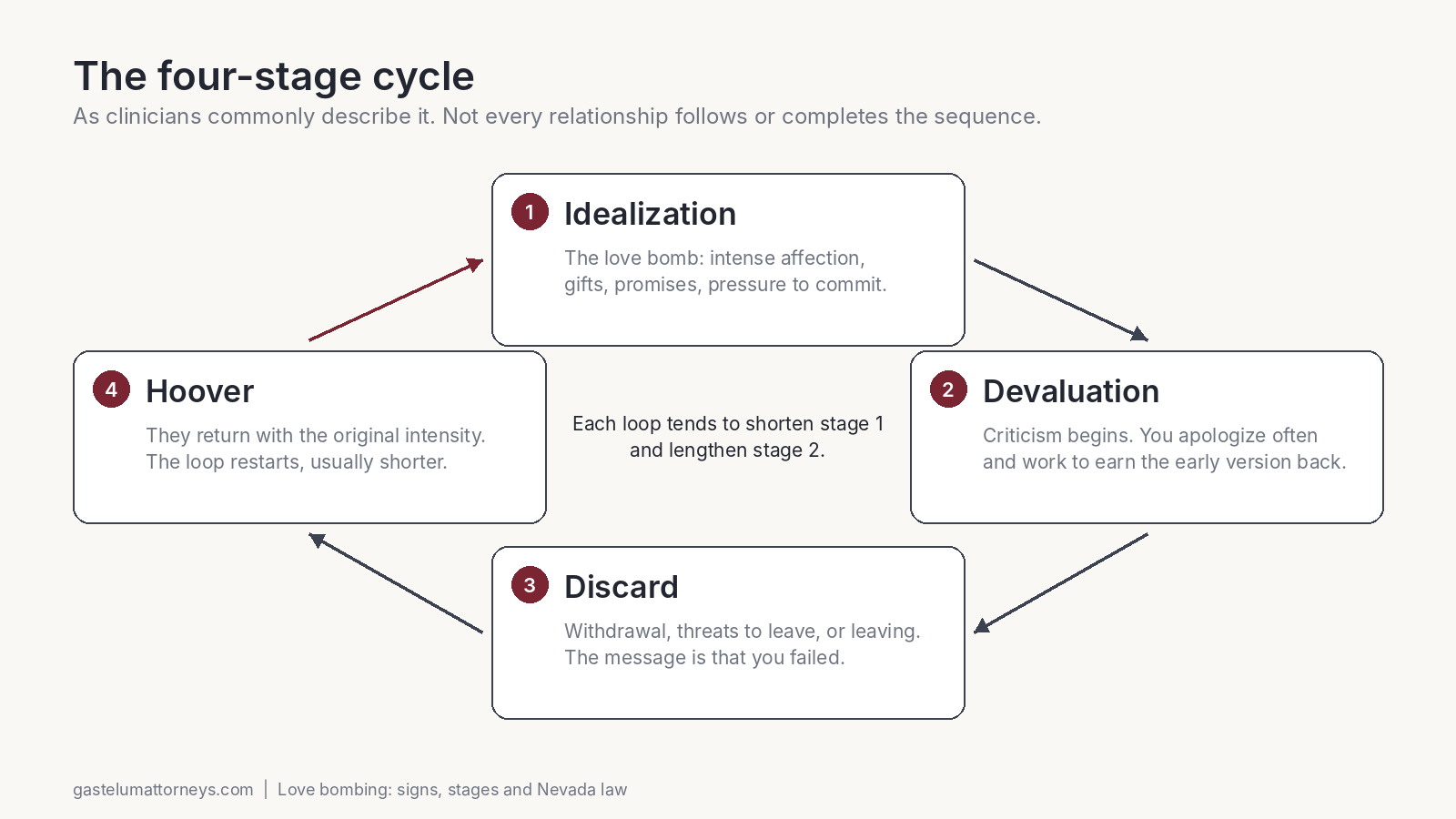
Love bombing is commonly described as the first of four stages in a manipulative relationship cycle: idealization, devaluation, discard and hoover. The pattern is intense affection, then withdrawal and criticism, then abandonment or threats of it, then a return to intense affection to pull you back in.
This is a clinical framework, not a law of nature. The names vary by author, and not every relationship follows the sequence or completes it.
- Idealization (the love bomb). You are everything they have been waiting for. Everything in the twelve signs above lives here.
- Devaluation. Small criticisms begin. The things they praised become things they mock. You find yourself apologizing often and working to earn back the early version of them.
- Discard. They withdraw, threaten to leave, or leave. Sometimes this is sudden; sometimes it is a long cold silence. The message is that you failed.
- Hoover. Named for the vacuum: they return with the original intensity, apologies, gifts and promises, and the cycle restarts. Each loop tends to shorten the idealization and lengthen the devaluation.
Our page on narcissistic abuse syndrome walks through what repeated cycles do to the person inside them, and our page on trauma bonding explains why leaving feels harder each time around.
Why do people love bomb?
People love bomb for different reasons, and not all of them are deliberate. Some are repeating a pattern they learned, some are managing their own fear of abandonment, and some are consciously building leverage. The reason matters less than the effect: whatever the motive, the recipient ends up attached, isolated and easier to control.
Love bombing is strongly associated in clinical writing with narcissistic traits, where the intensity is about being admired rather than about knowing you. It also appears in people with no personality disorder who move fast out of anxiety or inexperience. The distinguishing question is the one in the table above: what happens when you slow down. Anxiety adjusts. Manipulation punishes.
How long does love bombing last?
The love-bombing stage commonly lasts weeks to a few months, with no fixed length. It tends to end at the point where the other person feels secure that you are committed: after moving in, an engagement, a pregnancy, a shared lease or account, or your friends drifting away. The shift is usually tied to a commitment milestone rather than to a date on the calendar.
In relationships that cycle, each new love-bombing phase is usually shorter than the one before it. If you have been through the full idealization to hoover loop more than once, the early version of the relationship is unlikely to come back and stay.
What does love bombing look like inside a marriage?
Inside a marriage, love bombing usually appears as the hoover: a flood of affection, apologies and promises after a period of criticism, silence or a serious incident, often timed to a moment when you were considering leaving. It can also appear after an affair is discovered, when a spouse becomes attentive and generous in a way they had not been for years.
The question to ask is whether the change holds once the crisis passes. A spouse who is doing the work stays changed when you stop watching. A spouse who is love bombing returns to the prior pattern once you have unpacked the suitcase, canceled the consultation or stopped talking to the friend who noticed. Our pages on signs your partner is cheating and emotional neglect in marriage cover two of the situations where this pattern most often shows up.
Does love bombing matter under Nevada law?
No, not on its own. Love bombing is not a crime and is not a ground for divorce; Nevada is a no-fault state, and incompatibility is a sufficient cause under NRS 125.010. What matters legally is the conduct that can follow it: threats, coercion, stalking and harassment fall within Nevada’s definition of domestic violence under NRS 33.018.
Domestic violence is also a factor in every custody decision under NRS 125C.0035. Three places this shows up in a Clark County family case:
- Protective orders. Under NRS 33.020, a court may grant a temporary or extended order for protection when a verified application shows that an act of domestic violence has occurred or that a threat of domestic violence exists. NRS 33.018 defines domestic violence to include battery, assault, coercion under NRS 207.190, false imprisonment, and a knowing, purposeful or reckless course of conduct intended to harass the other person, including stalking. Dating relationships are covered, not only spouses.
- Custody. NRS 125C.0035(4) lists the factors the court considers in deciding a child’s best interest, including the level of conflict between the parents, each parent’s mental and physical health, and whether either parent has engaged in an act of domestic violence against the child, the other parent or anyone residing with the child. Under NRS 125C.0035(5), a finding by clear and convincing evidence that a parent committed domestic violence creates a rebuttable presumption that sole or joint physical custody by that parent is not in the child’s best interest. Our child custody lawyer page explains how those factors are applied.
- Divorce. You do not need to prove manipulation, or anything else, to end a marriage in Nevada. But if the pattern included financial control, hidden accounts or large gifts that are now disputed as loans, those facts can matter in the property division. Our Las Vegas divorce lawyer page covers what to expect.
Statutes: NRS 125.010, NRS 33.018, NRS 33.020, NRS 207.190, NRS 125C.0035
What should you do if you recognize this pattern?
Slow the pace and notice the response, unless you are already afraid of this person. In an early relationship with no history of threats, the clearest signal is how the other person handles an ordinary boundary: a weekend to yourself, a declined gift, a request to wait on a commitment. A healthy partner adjusts. A love bomber escalates, punishes or switches off.
If there has been any threat, violence, monitoring or fear, skip that test. Do not set a boundary to see what happens; go straight to steps 3 through 5 and talk to someone outside the relationship first.
- Name the pace out loud, if it is safe to. “I like you, and I want to take this slower.” The reaction is the information.
- Keep your people. Make the plans you would have made before the relationship. Isolation is the mechanism that makes the later stages work.
- Keep your own accounts, keys and documents. Shared finances and a shared lease are commitment milestones that often mark the end of the idealization stage.
- Write things down. If the relationship has moved into monitoring, threats or control, keep a dated record of what happened, screenshots of messages, and the names of anyone who saw it. Nevada courts have read NRS 200.620 to require the consent of all parties before a phone call is recorded, so rely on written messages and your own notes rather than secret recordings.
- Talk to someone outside the relationship. A therapist, a trusted friend, or a family law attorney if children, a marriage or a shared home are involved.
If you are in immediate danger, call 911. The National Domestic Violence Hotline is 1-800-799-7233 and is available at any hour.
Statute: NRS 200.620
Frequently asked questions about love bombing
Practical questions people ask once they understand the pattern above.
What phrases do love bombers use?
Common phrases are about speed and exclusivity: “I have never felt this way about anyone,” “You are my soulmate,” “I knew the moment I saw you,” “I cannot stop thinking about you,” “Nobody has ever understood me like you do,” and “Why do you need to see them when you have me?” The words themselves are not the problem. The pattern is: they arrive early, in volume, and are followed by hurt when you do not match the intensity.
What do love bombing texts look like?
A love-bombing text pattern is continuous: good-morning and good-night messages from the first week, long paragraphs about your future together, repeated check-ins during your workday, and a noticeable shift in tone (hurt, cold or passive) when your reply takes longer than they expect. Count the messages and notice how you feel about putting the phone down. Dread about reply time is the tell.
Is love bombing a narcissistic behavior?
Love bombing is commonly associated with narcissistic traits, but it is not proof of them, and it is not a diagnosis. The practical question is whether the affection turns into devaluation and control once you are committed. If it has, read the four stages above and our narcissistic abuse syndrome page, which covers what repeated cycles do and how people get out.
Can love bombing be unintentional?
Yes. Some people pour on affection because they are anxious about being left, because it is how they learned relationships work, or because they are infatuated and have not thought about pace at all. Unintentional love bombing still produces an unbalanced relationship, but it responds to a conversation. If you say “slower, please” and the person adjusts without punishment, that is a pace problem, not a control problem.
Is love bombing a sign of cheating?
It can be, in one specific form. A sudden wave of attention, gifts and affection from a long-term partner who had been distant is sometimes guilt or distraction after an affair, or an effort to keep you from looking closely. It can also be a sincere attempt to reconnect. Look at whether the warmth survives a hard question. Our signs your partner is cheating page lists the other indicators that tend to appear together.
Is love bombing a form of abuse?
Love bombing by itself is a manipulation tactic, not abuse in the legal sense. It becomes part of an abusive pattern when the dependence it creates is later exploited through control, isolation, threats or coercion. The Nevada law section above lists the conduct NRS 33.018 names. If any of it is happening, start a dated written record now; that record is what an attorney will ask for first.
Do I have to give back gifts from someone who love bombed me?
Usually the question only arises when the giver later claims the money was a loan, or says the gift was tied to a condition such as an engagement. Whether something was a gift or a loan turns on what was said and written at the time, and the answer can differ for money, property and anything given during a marriage. If large sums or property are involved, keep every message about the transfer and talk with an attorney before returning or spending anything.
Does love bombing affect custody in Nevada?
Not by itself; love bombing is not one of the best-interest factors in NRS 125C.0035. What can matter is a pattern of manipulation directed at the child, or at the other parent in front of the child, because the level of conflict and each parent’s ability to cooperate are factors the court weighs. Keep dated examples. Our child custody lawyer page explains how Clark County judges apply the factors.
Can I get a protective order for emotional manipulation in Nevada?
Not for manipulation alone. Emotional manipulation by itself is not on the list of conduct in NRS 33.018 that supports a protective order; the Nevada law section above explains what is. If the relationship has moved into stalking, threats, coercion or harassment, write down each incident with a date and ask an attorney whether the facts support an application under NRS 33.020.
How do I leave a relationship that started with love bombing?
Safety first, then planning. Leaving is when the hoover stage is most intense and, in controlling relationships, the point of highest risk; if you are in danger, leave and call 911 or the hotline above. If you have time, line up a place to stay, your documents, your own account and a person who knows the plan. If you share children or a home in Clark County, a family law attorney can ask for temporary orders when you leave. Our trauma bonding page covers why the pull back is so strong.
What should I bring to a consultation if I think this describes my marriage?
Bring a short written timeline of the relationship (when it started, when the pattern changed, any incidents with dates), screenshots of messages that show threats, monitoring or control, a list of shared accounts, property and debts, and anything involving the children. You do not need to have everything. Consultations are paid appointments, and payment plans and financing are available. You can request an appointment online or use the phone number at the end of this page.
How can Gastelum Attorneys help?
Gastelum Attorneys is a family law firm in Las Vegas, Nevada, founded on March 1, 2018, with eight attorneys and offices in Downtown Las Vegas and Summerlin. The firm represents clients in Clark County in divorce, child custody, child support, spousal support, adoption and guardianship matters, in English and Spanish.
If the relationship you are reading about is your marriage, and the pattern has moved into control, isolation or fear, we can explain what a protective order, temporary orders and a divorce would each look like on your facts, and which one to start with.
New Beginnings, Brighter Tomorrows.
Call (702) 979-1455 or contact us online. Se habla español.
About this page
Written by Jeremy Setters, LCSW (Nevada License No. 8762-C), and reviewed by Jennifer Setters, Managing Attorney at Gastelum Attorneys in Las Vegas, Nevada. Last updated . Statute citations are from the Nevada Legislature: NRS Chapter 33, NRS Chapter 125, NRS Chapter 125C, NRS Chapter 200 and NRS Chapter 207. This page is general information about a relationship pattern and Nevada law. It is not legal advice or a clinical assessment for a specific person or case.