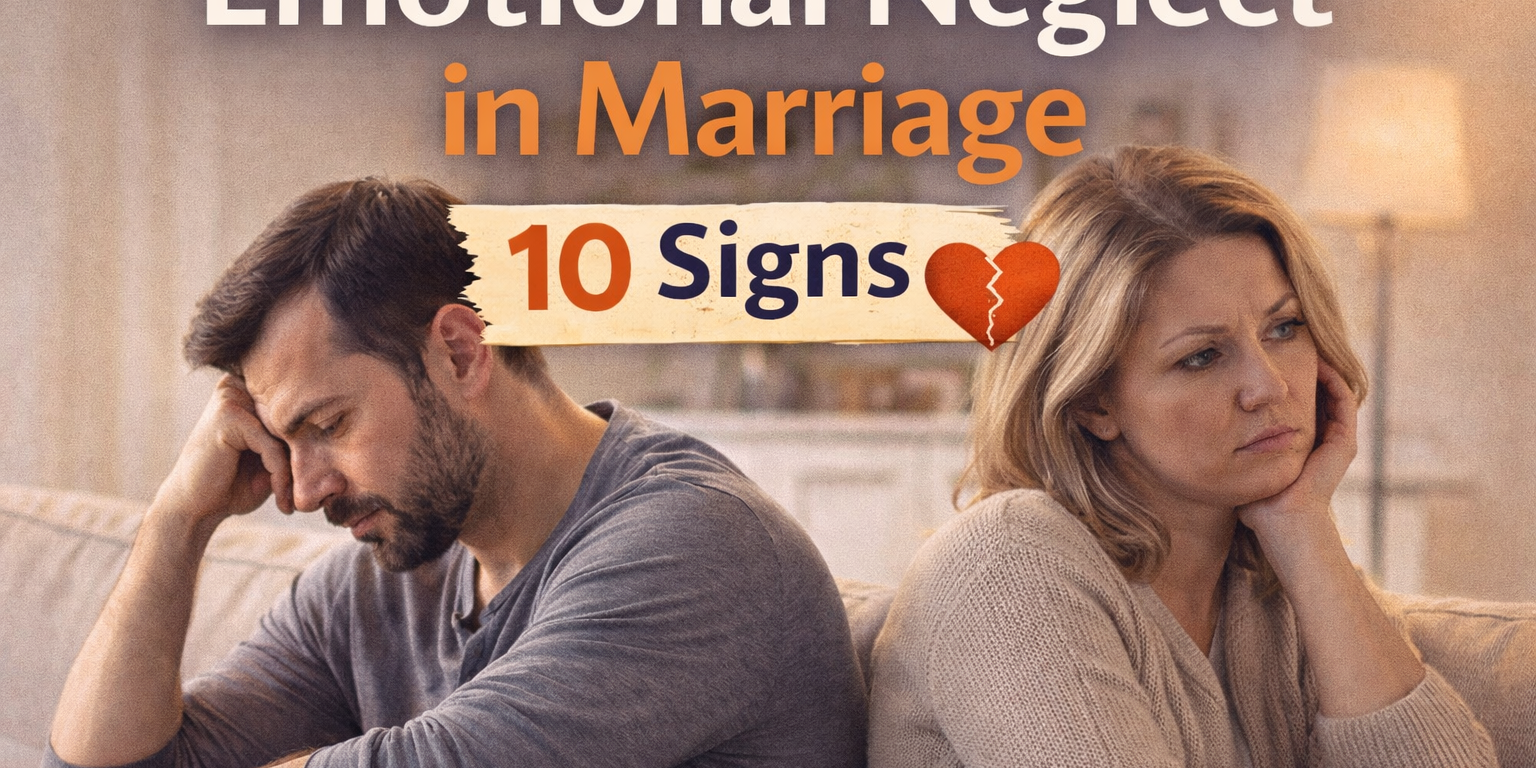
If you feel more alone with your spouse than when you are by yourself — read this first.
Emotional neglect in marriage doesn’t look like abuse from the
outside. There are no dramatic incidents, no obvious cruelty, no visible damage.
What there is — consistently, quietly, over years — is the absence of the
emotional presence you were promised. No comfort when you are struggling.
No curiosity about your inner life. No sense that you matter as a person,
not just as a function. The damage emotional neglect does is real.
And it is not your fault for needing more than you are getting.
Quick Answer: What Is Emotional Neglect in Marriage? (2026)
Emotional neglect in marriage is a pattern in which one or
both spouses consistently fail to meet their partner’s emotional needs —
not through overt harm but through absence: no emotional presence,
validation, comfort, or responsiveness. The 10 most consistent signs include
feeling invisible despite physical presence, surface-level conversations,
dismissed feelings, no comfort during difficulty, no curiosity about your
inner life, feeling lonelier with your spouse than alone, carrying all the
emotional labor yourself, not feeling like a priority, mechanical or absent
physical intimacy, and a growing distance neither partner addresses.
Key clinical distinction: emotional neglect is defined by
what doesn’t happen — not by what does.
Written by: Jeremy Setters, LCSW, License #8762-C &
Jennifer Setters, J.D., Nevada Bar #13126 ·
Gastelum Attorneys · Las Vegas, Nevada · April 2026
- Emotional neglect in marriage is defined by absence, not action — what your partner doesn’t do, not what they do.
- It can be unintentional — caused by upbringing, attachment style, or mental health — or deliberate and controlling. Both cause the same damage over time.
- Emotional neglect is the root cause pattern behind
miserable husband syndrome,
walkaway wife syndrome,
and many emotional affairs. - In Nevada, emotional neglect does not need to be proven as a legal cause for divorce. Under
NRS 125.010,
either spouse can file citing incompatibility — no fault required. - If you are uncertain whether what you are experiencing is emotional neglect or just a rough patch, the
Am I Ready for Divorce? assessment can help you evaluate where you stand.
Emotional neglect in marriage is among the most common — and
most misunderstood — patterns that family law attorneys and clinical therapists
see in Las Vegas. It is the experience of being in a marriage where the
emotional connection that was supposed to be there simply isn’t. Not because
of a single event. Not because of obvious cruelty. But because, consistently,
over months and years, your emotional needs have gone unacknowledged,
unresponded to, and unmet.
This page was written from both a clinical and legal perspective. The 10 signs
below reflect what a licensed clinical social worker observes in marriages
characterized by emotional neglect, and what the
Las Vegas family law attorneys at Gastelum Attorneys see in
the clients who arrive at this point — often after years of trying to name
something they couldn’t quite articulate.
Clinical and legal information for Nevada residents — not a substitute for
individual professional counsel. This page is part of the Gastelum Attorneys
Signs Your Marriage Is Over resource cluster.
and Gastelum Attorneys, Las Vegas, Nevada (2026).
What Is Emotional Neglect in Marriage?
Emotional Neglect in Marriage — Clinical Definition
Emotional neglect in marriage is a consistent pattern in which one or
both spouses fail to respond to, acknowledge, or provide for their
partner’s emotional needs. It is defined not by what happens but by
what doesn’t — the absence of emotional presence, validation, comfort,
and attunement.
Unlike physical abuse or overt emotional cruelty, emotional neglect
is often invisible from the outside — and frequently invisible to the
neglecting partner themselves. It can arise from avoidant attachment
styles, childhood emotional neglect carried into adulthood, untreated
depression or anxiety, or deliberate withholding used as a form of
control. Regardless of the cause, the impact on the neglected partner
accumulates over time in ways that are difficult to repair without
professional intervention.
The most important clinical distinction between emotional neglect and a
difficult patch in a marriage is duration and pattern.
Every marriage has periods of emotional distance — stress, illness,
overwork, parenting demands. Emotional neglect is not a temporary state.
It is a sustained, recurring failure to show up emotionally that has
become the baseline of the relationship rather than the exception.
10 Signs of Emotional Neglect in Marriage
1. You Feel Invisible Despite Being Physically Present
You share a home, meals, and a bed — but your spouse looks through you
rather than at you. You share something that matters and the response
is distracted, brief, or absent. You have been in the same room for
years without ever feeling truly seen by the person who was supposed to
know you best.
Clinically, this is one of the earliest and most persistent experiences
of emotional neglect — the gap between physical proximity and emotional
presence. It is often the first thing people describe when they begin to
name what has been wrong.
2. Conversations Stay Surface-Level — No Depth, No Curiosity
Logistics: who is picking up the kids, when the bill is due, what is
for dinner. No depth. No curiosity about what you’re thinking, feeling,
or working through. No conversation that resembles the ones you used to have.
Your spouse is not using you as an emotional resource — and they have
stopped being available as one.
The meaningful signal is the departure from a previous baseline. If
conversations used to go deeper and no longer do — not because of a
temporary circumstance but as the new permanent state — the emotional
connection has withdrawn, not just quieted temporarily.
3. Your Feelings Are Dismissed, Minimized, or Redirected
You raise something that matters to you emotionally — a worry, a hurt,
a need — and it gets minimized (“You’re overreacting”), redirected
(“You’re always making this about you”), or simply ignored. Over time,
most people in emotionally neglectful marriages stop raising their feelings
at all — not because they no longer have them, but because they have
learned that raising them leads nowhere.
That silence is not peace. It is the accumulated evidence that
your emotional life does not matter to your partner. And the
cumulative damage of that message, received repeatedly over years,
is what the rest of this page is about.
4. No Comfort When You Are Struggling
You are sick, grieving, scared, or overwhelmed — and your spouse is
functionally absent. Not cruel. Not actively dismissive. Just not there
in any way that feels like support. They may be in the same house.
They may ask if you need anything. But the emotional attunement — the
sense that they are genuinely present with you in your difficulty —
is missing.
Adult attachment research consistently shows that the way a partner
responds (or fails to respond) during moments of vulnerability is
one of the strongest predictors of long-term relationship satisfaction.
Repeated failure to provide comfort during difficulty creates an attachment
injury that compounds over time.
Understanding your legal options does not mean your marriage is over.
It means you have accurate information when you need it most.
Gastelum Attorneys handles divorce and family law exclusively in Clark County.
“I didn’t realize how long I had been feeling invisible in my own marriage until I saw it described clearly. Gastelum Attorneys helped me understand what my options were without any pressure. Just clarity.”
— Las Vegas client, divorce case, Clark County | ★★★★★
5. Your Spouse Has No Curiosity About Your Inner Life
Your goals, fears, the things that excite or worry you, the experience
you had last week that stayed with you — none of it is interesting to
your spouse. They do not ask. When you share something unprompted,
the conversation moves on quickly. You have stopped volunteering
the deeper things because you have learned they go nowhere.
Curiosity about a partner’s inner life is one of the foundational elements
of what Gottman calls “love maps” — the detailed knowledge of a partner’s
inner world that distinguishes deeply connected couples from those who
coexist. A spouse with no curiosity about your inner life has stopped
investing in that map.
6. You Feel More Lonely With Your Spouse Than When You Are Alone
This is the single clearest experiential sign of emotional neglect in
marriage — and the one most people describe as the moment they realized
something was genuinely wrong. Being alone doesn’t feel lonely. Being
with your spouse does. The absence of connection when connection is
expected is experienced as a more acute form of loneliness than the
ordinary solitude of being by yourself.
If you recognize this experience, you are not imagining it and you are
not asking for too much. You are describing the impact of sustained
emotional absence in a relationship where emotional presence was promised.
7. You Carry All the Emotional Labor
You are the one who notices when something is wrong. You are the one
who initiates difficult conversations, maintains the social relationships,
tracks the emotional state of the children, and holds the emotional
architecture of the household together. Your spouse participates in
logistics. You do all the relational and emotional work.
Unequal emotional labor is exhausting in practical terms — and damaging
in relational terms. When one partner is doing all the work of
maintaining a marriage’s emotional health, resentment accumulates.
The working partner feels unseen in their effort and increasingly
unwilling to sustain it.
8. You Do Not Feel Like a Priority
Work, phone, friends, hobbies, obligations — all of it takes precedence
over you, consistently and without apparent awareness on your spouse’s
part. Not occasionally, which is normal. Consistently, as the established
pattern of your life together. When something genuinely matters to you,
it competes for space with everything else in your spouse’s life — and
frequently loses.
Not sure if your marriage is in a rough patch or something more serious?
The Am I Ready for Divorce? assessment evaluates your
situation across 6 clinical dimensions. It was built specifically for the
moment of uncertainty you may be in right now.
9. Physical Intimacy Is Mechanical or Has Disappeared
Emotional and physical intimacy are closely linked. When emotional
connection withdraws, physical intimacy typically follows — not
immediately, but reliably. What may remain is physical contact that
feels mechanical, disconnected, or performed rather than genuinely
intimate. You may feel touched but not desired. Held but not known.
The absence of emotional safety in a marriage directly undermines
sexual intimacy. Most people experiencing emotional neglect describe
a loss of desire that is not about physical attraction but about the
absence of the emotional connection that makes physical intimacy feel
meaningful.
10. The Distance Has Been Growing — and Neither of You Has Named It
This is often the last sign to become visible — and the most diagnostic.
The emotional distance is real, it has been growing, and neither partner
has named it directly or taken action to address it. Either the neglecting
partner is unaware, or both partners have reached a state of quiet
resignation where naming the distance feels futile.
When both signs 9 and 10 are present simultaneously — mechanical or absent
intimacy combined with an unaddressed and growing distance — the marriage
has often crossed a threshold that is difficult to return from without
immediate and intensive professional intervention. This is the stage most
consistent with the patterns described in our hub page on
the signs your marriage is over.
What Causes Emotional Neglect in Marriage?
Understanding the cause of emotional neglect in a specific marriage affects
both whether couples therapy can address it and what approach is likely
to work. The most common clinical patterns are:
Avoidant Attachment Style
Partners with an avoidant attachment style are typically uncomfortable
with emotional intimacy — not because they don’t care, but because
closeness triggers a threat response rooted in early childhood experiences.
They may shut down during emotional conversations, go quiet when their
partner is distressed, or seem emotionally unreachable in moments when
connection is most needed. This is often unintentional but causes the
same damage as deliberate neglect from the partner’s perspective.
Childhood Emotional Neglect Carried Into Adulthood
Adults who grew up in households where emotional needs were routinely
unmet often don’t recognize emotional neglect as a pattern because it
feels normal to them. They may genuinely not understand what emotional
attunement looks like in practice, because they never experienced it
consistently as children. This does not excuse the pattern — but it
explains why some partners who emotionally neglect their spouses are
genuinely unaware that anything is wrong.
Untreated Depression, Anxiety, or Other Mental Health Conditions
Depression in particular frequently presents as emotional withdrawal,
reduced responsiveness, and loss of interest in connection — which
from the outside looks exactly like emotional neglect. A partner whose
depression is unacknowledged or untreated may be experiencing their own
profound emotional absence while simultaneously failing to meet their
spouse’s needs. This pattern is closely associated with
miserable husband syndrome.
Accumulated Resentment and Defensive Withdrawal
Emotional neglect can also develop as a response to unresolved conflict
or accumulated resentment. A partner who has felt criticized, controlled,
or unappreciated over years may progressively withdraw emotional investment
as a form of self-protection. This withdrawal is experienced by the other
partner as neglect — even though, from the withdrawing partner’s perspective,
it is a response to their own unmet needs.
Narcissistic Traits or Personality Patterns
Partners with narcissistic traits typically have a fundamental deficit
in empathy that makes genuine emotional attunement difficult or impossible.
Emotional neglect in these relationships is not incidental — it is
structural. The narcissistic partner is unable to consistently prioritize
their spouse’s emotional needs because the capacity for sustained empathy
is limited. This pattern is among the hardest to address in couples therapy.
When Emotional Neglect Becomes Emotional Abuse
Emotional neglect exists on a spectrum. At one end is the unintentional,
unaware pattern — a partner who is emotionally unavailable due to their
own history and limitations without intent to harm. At the other end is
deliberate emotional withholding used as a form of control — giving or
withdrawing emotional presence as punishment, using silence as a weapon,
or consistently invalidating a partner’s reality to maintain power.
The clinical markers that distinguish neglect from abuse include:
whether the withholding appears to be deliberate and tied to control;
whether the partner uses emotional withdrawal as a punishment mechanism;
whether the neglected partner has been made to feel that their emotional
needs are pathological rather than legitimate; and whether the pattern
has escalated alongside other controlling behaviors — financial control,
isolation from support networks, or coercive monitoring.
If you are experiencing the latter pattern, the legal implications are
more urgent. While Nevada is a no-fault divorce state and emotional
abuse does not need to be proven to file for divorce, coercive control
patterns can be relevant in custody determinations and in establishing
a protective legal structure before separation. Speak with a
Las Vegas family law attorney before
making any moves if coercive control is part of your situation.
How Emotional Neglect Connects to Other Marriage Patterns
Emotional neglect in marriage rarely exists in isolation. It is the root
cause pattern that generates most of the other patterns we see in clinical
and legal practice:
Walkaway wife syndrome
is almost always the end-stage response to years of emotional neglect.
A wife who has raised her emotional needs repeatedly and had them go
unmet eventually reaches a private point of no return — not as a sudden
decision but as the end of a long process of accumulated unmet needs.
The walkaway wife pattern is what emotional neglect looks like when it
has been sustained long enough to destroy the emotional investment that
held the marriage together.
Miserable husband syndrome
describes the pattern from the other direction — a husband who has
emotionally withdrawn from his marriage, often due to unacknowledged
depression or emotional disconnection, and who is experiencing the
relationship as a source of chronic low-grade suffering rather than
support. Emotional neglect — both experienced and enacted — is central
to this pattern.
Emotional affairs
frequently develop as a response to emotional neglect. A partner who
is not getting emotional attunement, validation, or genuine connection
in their marriage is more vulnerable to seeking it elsewhere — initially
in what feels like a meaningful friendship, which progressively crosses
into emotional affair territory.
Can a Marriage Recover from Emotional Neglect?
Yes — but recovery requires several specific conditions to be in place.
The research on couples therapy outcomes and the clinical experience of
both authors of this page suggest the following honest picture:
Recovery is genuinely possible when: the emotional neglect has been
unintentional and the neglecting partner is willing to acknowledge the
pattern clearly; both partners engage with a therapist experienced in
attachment and emotional neglect; the neglecting partner is willing
to do individual work alongside couples work; and the neglected partner
still has enough emotional investment in the relationship to sustain
the recovery process.
Recovery is significantly harder — and in many cases not realistic —
when: the neglecting partner denies the pattern or attributes the problem
entirely to the other person; the neglect has been sustained for so long
that the neglected partner has already emotionally checked out; narcissistic
traits are the primary driver of the pattern; or the neglect has crossed
into deliberate emotional abuse and control.
If you are uncertain which situation applies to your marriage, a honest
assessment of where you stand — across the 10 signs above and against
the broader signs your marriage is over —
is a necessary first step before deciding whether to pursue recovery or
to understand your legal options.
“Years of feeling unheard. Jennifer’s team explained Nevada law clearly and helped me protect myself and my children without judgment. I finally felt like I had an advocate.”
— Henderson client, divorce case, Clark County | ★★★★★
Emotional Neglect in Marriage — Nevada Law
Nevada is a no-fault divorce state under
NRS 125.010.
Emotional neglect does not need to be named, proven, or documented to
file for divorce in Clark County. Either spouse can file citing
incompatibility — the most common ground used in Nevada — without
any obligation to explain why the marriage ended.
However, the circumstances of emotional neglect in your marriage may
be relevant in several specific ways:
Financial Control Connected to Emotional Neglect
When emotional neglect has been accompanied by financial control —
restricted access to accounts, unilateral financial decisions, or
deliberate financial isolation — the financial dimension of the marriage
becomes relevant in property division. Nevada is a community property
state. Assets and debts accumulated during the marriage are generally
divided equally, but financial misconduct during the marriage can affect
how that division is determined. A
Las Vegas divorce attorney
can help you understand what documentation matters in your specific situation.
Effect on Children and Custody
Under NRS 125C.0035,
Clark County Family Court determines custody based on the best interests
of the child. Emotional neglect of a spouse does not automatically translate
to a finding of inadequate parenting — but if the emotional unavailability
that characterized the marriage has also affected the parent’s engagement
with the children, that can become relevant in custody proceedings.
Our Las Vegas child custody attorneys
can help you evaluate what the court is likely to consider.
Understanding Your Position Before Any Action
If emotional neglect has been the dominant pattern in your marriage and
you are beginning to consider your options, the most important step is
to understand your legal and financial position in Nevada before taking
any action that could affect subsequent proceedings. A confidential
consultation with Gastelum Attorneys does not commit you to divorce —
it gives you the information to make an informed decision, whatever
that decision is.
Gastelum Attorneys has guided more than 5,000 families through divorce
and custody matters in Clark County. Bilingual English/Spanish team.
Exclusively Nevada family law.
Nevada License #8762-C · Licensed Clinical Social Worker ·
Specialization in marriage dissolution, emotional neglect patterns,
relationship systems, and family dynamics · Co-Parenting Index
methodology · Las Vegas, Nevada. Clinical content on this page
reflects professional clinical training and direct experience with
emotional neglect patterns in marriage.
Jennifer Setters, J.D.
Nevada Bar #13126 · Founder & Managing Attorney, Gastelum Attorneys ·
UNLV Criminal Justice B.S. · Boyd School of Law J.D. ·
Clark County Family Court · Eighth Judicial District ·
5,000+ Nevada family law cases. Legal section reviewed for
accuracy under current Nevada statutes.
This content provides general clinical and legal information and does not
constitute therapy or legal advice. Consult a licensed mental health
professional and/or Nevada family law attorney for guidance specific to
your situation. Last reviewed: April 2026.
“Bilingual team, compassionate approach. They explained everything in both English and Spanish and never made me feel like I was overreacting. I wasn’t.”
— North Las Vegas client, divorce case, Clark County | ★★★★★
Signs Your Marriage Is Over ·
Miserable Husband Syndrome ·
Walkaway Wife Syndrome ·
Stages of Emotional Affair ·
Am I Ready for Divorce? (Quiz) ·
Signs Your Partner Is Cheating ·
Signs Your Marriage Will Survive Infidelity ·
Las Vegas Divorce Attorney ·
Child Custody Lawyer Las Vegas
Frequently Asked Questions
What is emotional neglect in marriage?
Emotional neglect in marriage is a consistent pattern in which one or both spouses fail to respond to, acknowledge, or provide for their partner’s emotional needs — characterized by the absence of emotional presence, validation, comfort, and attunement rather than overt harmful action. It is defined by what doesn’t happen, not by what does.
What are the signs of emotional neglect in marriage?
The 10 most consistent signs are: feeling invisible despite physical presence; surface-level conversations with no depth or curiosity; dismissed or minimized feelings; no comfort when you are struggling; no curiosity about your inner life; feeling lonelier with your spouse than when alone; carrying all the emotional labor yourself; not feeling like a priority; mechanical or absent physical intimacy; and a growing emotional distance neither partner addresses.
Is emotional neglect in marriage the same as emotional abuse?
Not always. Unintentional emotional neglect — caused by avoidant attachment, upbringing, or mental health challenges — is different from deliberate emotional withholding used as a form of control. Both cause significant damage over time. When neglect is intentional, sustained, and tied to controlling behavior, it crosses into emotional abuse territory. If you are in this situation in Las Vegas, contact Gastelum Attorneys at (702) 979-1455 to understand your legal options.
Can emotional neglect in marriage lead to divorce?
Yes. Emotional neglect is one of the most common root causes of walkaway wife syndrome, miserable husband syndrome, and emotional affairs — all of which frequently precede divorce. In Nevada, emotional neglect does not need to be proven — Nevada is a no-fault state under NRS 125.010, and either spouse can file citing incompatibility without proving marital misconduct.
What causes emotional neglect in marriage?
The most common causes are: avoidant attachment style, childhood emotional neglect carried into adulthood, untreated depression or anxiety, accumulated resentment causing defensive withdrawal, and narcissistic traits that limit the capacity for empathy. Understanding the cause matters for whether couples therapy can realistically address it.
Can a marriage recover from emotional neglect?
Yes, when the neglect has been unintentional, the neglecting partner is willing to acknowledge the pattern, and both partners engage in couples therapy before the neglected partner has fully emotionally checked out. Recovery is significantly harder when the pattern is deliberate, when narcissistic traits are the primary driver, or when the neglect has been sustained long enough that the neglected partner has already privately reached a point of no return.
What does Nevada law say about emotional neglect and divorce?
Nevada is a no-fault state under NRS 125.010. Emotional neglect does not need to be proven or named. Either spouse can file for divorce citing incompatibility. If emotional neglect was accompanied by financial control or coercive behavior, those elements may be relevant in property division and custody proceedings in Clark County Family Court.
Disclaimer: This page provides general clinical and legal information only and does not constitute therapy or legal advice. Consult a licensed mental health professional and/or qualified Nevada attorney for guidance specific to your situation.
Experiencing Emotional Neglect in Your Las Vegas Marriage?
Whether you are still working toward recovery or beginning to consider your
legal options, Gastelum Attorneys provides confidential guidance for Las Vegas,
Henderson, and North Las Vegas families. More than 5,000 Clark County cases.
Bilingual English/Spanish team. Exclusively Nevada family law.
New Beginnings, Brighter Tomorrows