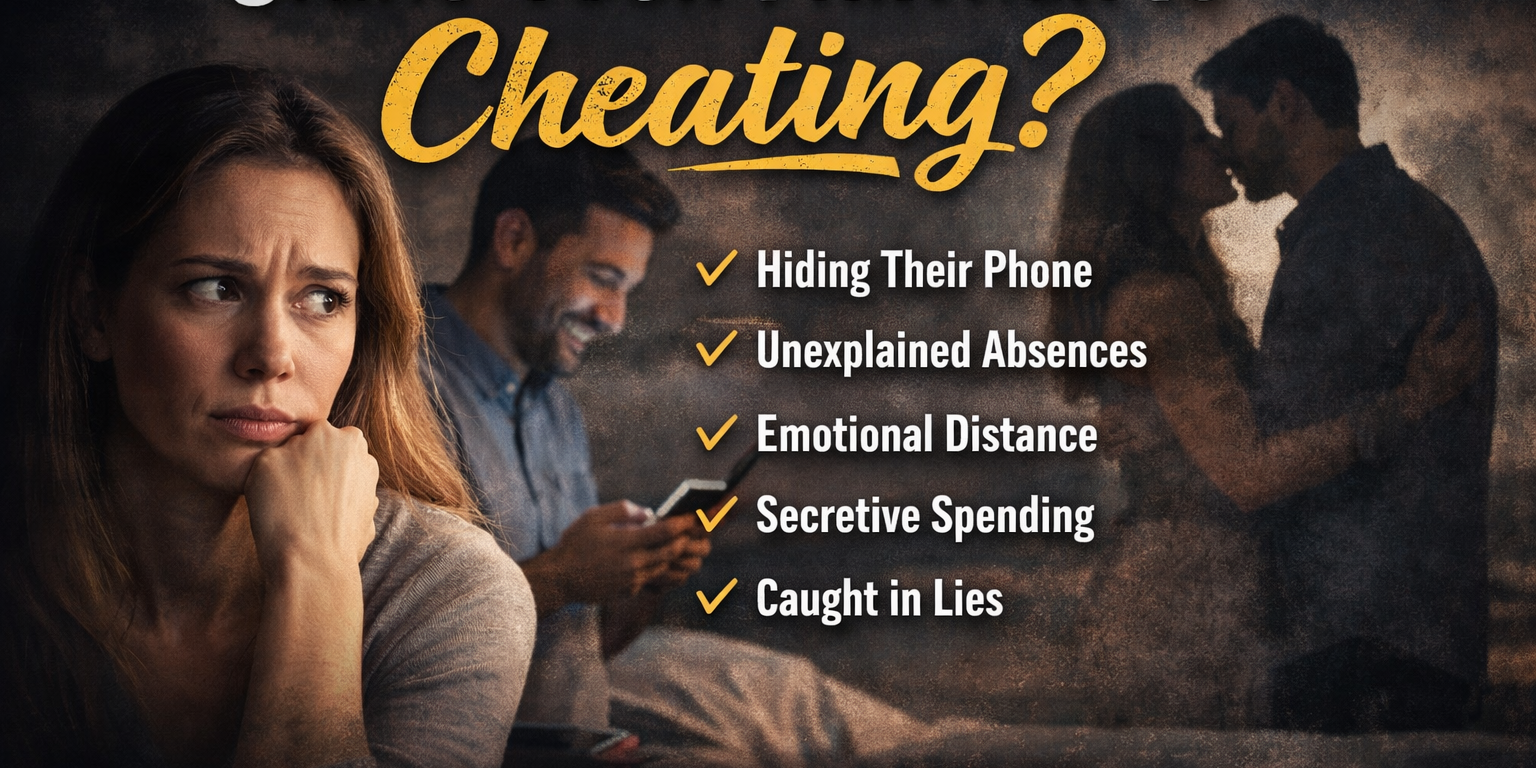
Quick Answer: Signs Your Partner Is Cheating (2026)
The most consistent signs your partner is cheating
include: increased phone secrecy, unexplained absences, emotional
withdrawal, changes in intimacy, defensive behavior when questioned,
new unexplained contacts, and unexplained financial activity. The
most overlooked sign is when they stop arguing —
not because things improved, but because they stopped being
emotionally invested in the relationship.
Last reviewed: March 2026 by
Jennifer Setters, J.D.,
Nevada Bar #13126 · Gastelum Attorneys · Las Vegas, Nevada
- The signs your partner is cheating rarely arrive as a single
dramatic event — they build through small behavioral
shifts over weeks or months. - The most dangerous sign is emotional withdrawal combined
with unexplained contentment — a partner who seems
unusually at peace while being distant may have found emotional
fulfillment elsewhere. - In Nevada, adultery does not directly affect
divorce outcomes under no-fault law — but if marital assets were
used to fund the affair, courts can address that in property
division. - Nevada has strict wiretapping and electronic surveillance laws —
certain evidence-collection methods are illegal and can expose
you to criminal liability. Consult an attorney before
recording any conversation or accessing accounts. - A partner’s gut feeling about infidelity tends to be more
accurate than most people expect — because you know the
behavioral baseline of your relationship better than any
outside observer.
Recognizing the signs your partner is cheating is rarely
straightforward. Infidelity doesn’t announce itself — it shows up as a
pattern of small behavioral changes that each seem individually explainable
but that, taken together, point to something deeper. If your instincts are
telling you something is wrong, you may already be reading the signals
before you’ve consciously accepted what they mean.
Below are the 15 most consistent warning signs your partner may be
cheating, alongside what infidelity means under Nevada law
and what your options are in Las Vegas if your concerns are confirmed.
Our Las Vegas family law attorneys work regularly with
clients navigating exactly this moment — where personal reality and
legal consequence meet in Clark County Family Court.
Legal information for Nevada residents — not a substitute for individual legal counsel.
Consult a licensed Nevada family law attorney for guidance specific to your situation.
Las Vegas family law attorneys at Gastelum Attorneys (2026).
2. Unexplained Absences
3. Emotional Withdrawal
4. Changes in Intimacy
5. Defensive Behavior
6. New Unknown Contacts
7. Unexplained Finances
8. Appearance Changes
9. Guilt Overcompensation
10. Social Media Changes
11. No Future Planning
12. Gaslighting
13. Online Attention to Others
14. Loss of Shared Interest
15. Your Gut Instinct
Nevada Law & Infidelity
What to Do Next
FAQs
15 Signs Your Partner Is Cheating
1. Increased Phone and Device Secrecy
One of the clearest signs your partner is cheating is a sudden shift
in how they handle their phone. A device that was previously left on
the counter is now always face-down, password-changed, or carried
everywhere. Conversations pause when you walk in. Screens tilt away.
New apps appear that weren’t there before.
The meaningful signal is a recent change in existing behavior
— not habits that have always been present. Sudden shifts, not
long-standing privacy preferences, are what matter here.
2. Unexplained Absences — A Common Sign of a Cheating Partner
Working late becomes a regular occurrence with no increase in income
or deliverables to show for it. New commitments appear — gym classes,
work events, errands — that account for hours without specific details.
When pressed, stories are vague, slightly inconsistent, or change between
tellings. Credit card activity shows purchases at times and locations that
don’t match the stated schedule.
3. Emotional Withdrawal and Distance
Your partner is physically present but emotionally somewhere else.
Shared conversations feel surface-level and logistics-focused — no
depth, no curiosity about your day. They seem distracted, checked out,
or content in a way that doesn’t track with anything in your shared life.
Emotional energy that used to go into the relationship is going somewhere
else — and this is consistently among the first signs your partner is
cheating that people recall in hindsight.
4. Changes in Intimacy
Both increases and decreases in intimacy can signal infidelity. A
sudden disinterest may reflect guilt or emotional investment elsewhere.
An unexpected increase — particularly new behaviors after a long
period of distance — can reflect guilt-driven overcompensation.
What matters is an unexplained change from the established
baseline in your specific relationship.
5. Defensive or Accusatory Behavior When Questioned
When you ask a reasonable question about their schedule or a contact
in their phone, the response is disproportionate — immediate anger,
deflection, or counter-accusations that you are being controlling or
paranoid. Turning the accusation back on you (“Are you the
one cheating?”) is a specific deflection pattern. Defensiveness at
a level that doesn’t match the stakes of the question is a consistent
behavioral sign of a cheating partner who is managing a secret.
Understanding your legal options doesn’t mean you’ve made a decision.
It means you’re informed before you act.
“I came to Gastelum Attorneys not knowing what my rights were or what to do next. Jennifer’s team explained everything about Nevada law clearly and without pressure. I finally felt like I had a clear path forward.”
— Las Vegas client, divorce case, Clark County | ★★★★★
6. New People You’ve Never Met
A new “work friend,” a gym contact, a “colleague” who comes up
frequently but whom you’ve never been introduced to and who doesn’t
appear on any work roster you’re aware of. When you ask to meet them
or ask clarifying questions, the answers are vague or the topic
changes. A partner with nothing to hide has no reason to keep a person
in their life completely separated from you.
7. Unexplained Financial Activity
Cash withdrawals that don’t correspond to known expenses. Charges at
restaurants, hotels, or retailers that don’t match any shared activity.
A new credit card or account you weren’t told about. Reduced access to
previously shared financial information.
In Nevada, if marital funds were used to finance an affair — hotel
stays, gifts, travel — this is considered dissipation of
community property and can affect property division and
spousal support in Las Vegas
even under no-fault divorce law. This financial trail is often among
the first evidence our Las Vegas divorce attorneys
examine in cases involving suspected infidelity.
8. Sudden Changes in Appearance
A new wardrobe, new fragrance, significantly more attention to
grooming — without a corresponding change in job, lifestyle, or stated
goal. People invest in their appearance when they feel there is an
audience that matters to them. If the change doesn’t connect to
anything in your shared life, it may connect to something outside of it.
9. Guilt-Driven Overcompensation
Unusual gifts, spontaneous affection, an uncharacteristic eagerness
to please — sometimes the behavioral shift goes in the opposite
direction. A guilty partner may temporarily overcorrect, becoming
notably kinder or more attentive than usual, in cycles that don’t
correlate with anything in the relationship itself.
10. Changed Social Media Behavior
Accounts go private or are deleted. A partner who used to tag you in
posts no longer does. New accounts you weren’t told about appear.
Social media creates a digital record, and a partner managing a
parallel relationship typically either stops using platforms you share
access to or creates separate ones.
11. Reduced Investment in Your Shared Future
They stop making plans. Conversations about vacations, home improvements,
or financial goals are deferred or deflected. A partner planning an exit
tends to stop investing emotionally in a future they don’t intend to
be part of.
12. Gaslighting — A Telling Sign of a Cheating Partner
When you raise a concern, you’re told you’re irrational, too sensitive,
paranoid, or controlling. The problem becomes your insecurity rather
than their behavior. If expressing a reasonable concern
consistently results in you apologizing, that behavioral pattern is
worth noting — it is one of the most consistently reported
signs your partner is cheating among people who later confirmed
their suspicions.
13. Unusual Online Attention to Specific People
Consistently liking, commenting on, or interacting with one specific
person’s content. Direct message notifications at unusual hours. A
name appearing frequently in online activity that doesn’t correspond
to anyone in your shared social circle. Digital communication is
where many affairs begin and where behavioral patterns often first
become visible.
14. Loss of Interest in Shared Activities
Things you used to do together — weekend routines, shows, places you
went — are no longer interesting to them. When emotional investment
moves elsewhere, the activities connected to that investment tend to
go quiet alongside it.
15. Your Gut Instinct — Often the First Sign
Therapists and family law attorneys who work regularly with infidelity
cases consistently note that a partner’s instinct about cheating tends
to be accurate at a higher rate than most people expect. You know the
behavioral baseline of your relationship better than any outside
observer. The accumulation of small signals that each seem individually
explainable, but that together feel wrong, is often how people first
register the signs your partner is cheating — before any confirmation.
That instinct deserves to be taken seriously, not dismissed.
Seeing several of these signs in your Las Vegas marriage?
Before taking any action — including confronting your partner or
attempting to collect evidence — understand your legal position first.
Nevada law has specific rules about what evidence is admissible and
what constitutes illegal surveillance. A conversation with a Clark
County family law attorney can help you protect yourself before you act.
Waiting can affect your financial and custody position.
“I was terrified about what divorce would mean for my finances and my kids. The attorneys at Gastelum walked me through Nevada’s community property laws and helped me understand exactly what I was entitled to protect.”
— Henderson client, divorce case, Clark County | ★★★★★
What Cheating Means Under Nevada Law
Nevada is a no-fault divorce state under
NRS 125.010. Infidelity by itself is not a legal
ground for divorce and does not automatically affect property division,
spousal support, or custody. Either spouse can file citing incompatibility
without proof of wrongdoing. Even when the signs your partner is cheating
are confirmed, Nevada law treats the divorce itself as a no-fault matter.
However, infidelity is not legally irrelevant. There are three specific
ways it can affect your case:
1. Dissipation of Marital Assets
If marital funds were used to finance the affair — hotel stays, gifts,
travel, or financial support given to the other person — this is
considered dissipation of community property under Nevada law. The
court can factor this into property division, compensating the
non-offending spouse for funds spent on the affair. How this dissipation
is documented and presented also affects spousal support
calculations in Las Vegas — the financial picture of the marriage
matters in both property and support determinations. Financial
documentation can therefore matter significantly even in a no-fault filing.
2. Credibility in Custody Disputes
Infidelity alone does not affect custody under
NRS 125C.0035, which focuses on the best interests
of the child. However, if the circumstances of the affair directly
affected the children — exposure to the other person, neglect of
parenting duties, behavioral changes affecting parenting — it can
become relevant. Our Las Vegas
child custody attorneys and child
support attorneys work together on cases where infidelity intersects
with parenting and financial obligations in Clark County Family Court.
3. Evidence Collection and Nevada Privacy Law
Nevada has strict laws governing the recording of conversations and
electronic surveillance. Recording a private conversation without
proper consent can violate Nevada wiretapping statutes and may result
in criminal exposure regardless of marital status. Evidence collected
this way is also inadmissible in legal proceedings.
Before taking any steps to confirm the signs your partner is
cheating — accessing accounts, recording conversations, installing
tracking software — speak with a Las Vegas family law attorney.
What is legally permissible depends on how and where the information
is collected.
Confirming a cheating partner does not automatically give you legal
advantages in a Nevada divorce — but how marital assets were used
during the affair, and how you document what happened, can both
affect your outcome. Gastelum Attorneys handles divorce and
custody cases
throughout Clark County.
What to Do When You See the Signs
Step 1: Document What You’re Observing
Before confronting your partner, create a private written record of
the specific behavioral patterns you’ve observed — dates, times,
behaviors, and discrepancies in stories. Keep this somewhere secure.
This creates clarity for you and ensures an accurate record before
emotions intensify.
Step 2: Understand Your Financial Position
Quietly review your shared financial situation: joint accounts, debts,
assets, and insurance policies. In Nevada, community property rules
mean that financial decisions made during the marriage affect both
spouses equally. Knowing what you share protects you if divorce
becomes a reality.
Step 3: Know What Evidence Is Legally Permissible
Nevada has strict laws around surveillance and privacy. Before taking
any steps to confirm the signs your partner is cheating, speak with a
Nevada family law attorney. The legality of evidence collection depends
on the specific method and circumstances.
Step 4: Decide What You Want for Your Marriage
Some marriages survive infidelity. Many do not. Both outcomes require
deliberate decisions — not reactive ones made in the immediate aftermath
of discovery. If reconciliation is possible, couples therapy provides
structure. If it is not, understanding your legal options before any
confrontation puts you in a stronger position.
Step 5: Consult a Las Vegas Family Law Attorney First
Whether you are considering confrontation, separation, or divorce,
speaking with an attorney first gives you a clear picture of your
rights, your options, and what to protect. If both spouses can
ultimately agree on terms, an uncontested
divorce in Las Vegas resolves the case faster and at lower cost
than litigation. Where significant disagreement exists — over property,
support, or children — our contested
divorce attorneys in Las Vegas handle the full process in Clark
County Family Court. The steps taken immediately after recognizing the
signs your partner is cheating can significantly affect the outcome of
any subsequent legal proceedings.
Emotional Recovery After Infidelity
Discovering a cheating partner is one of the most destabilizing
experiences in a relationship. The emotional impact — grief, anger,
self-doubt, loss of trust — is real and valid regardless of whether
you ultimately stay or leave. Prioritizing your mental health during
this period is not optional; it is the foundation for every other
decision you will make.
Professional counseling — whether individual therapy or couples therapy
if both partners are willing — provides tools and structure that friends
and family cannot. A therapist helps you separate emotional responses
from practical decisions, which matters when those decisions carry
legal and financial consequences.
If you are also navigating what comes next legally, the attorneys at
Gastelum Attorneys work with Las Vegas clients at exactly this
intersection. You do not need to have made a decision to speak with us.
Understanding your options is the first step toward clarity.
Reviewed by Jennifer Setters, J.D.
Nevada Bar #13126 · Founder & Managing Attorney,
Gastelum Attorneys ·
UNLV Criminal Justice B.S. · Boyd School of Law J.D. ·
Clark County Family Court · Eighth Judicial District ·
This content is for general informational purposes and does not
constitute legal advice. Nevada law is complex and fact-specific —
consult a licensed Nevada family law attorney for guidance on your
situation. ·
Last reviewed: April 2026
“The bilingual team made all the difference. They explained every step in both English and Spanish and made sure I never felt lost. I would not have navigated Clark County Family Court without them.”
— North Las Vegas client, divorce case, Clark County | ★★★★★
Walkaway Wife Syndrome: 7 Warning Signs ·
Stages of an Emotional Affair ·
What to Do Legally If Your Husband Is Cheating ·
Signs Your Marriage Will Survive Infidelity ·
Las Vegas Divorce Attorney ·
Child Custody Lawyer Las Vegas
FAQs About Signs Your Partner Is Cheating
What are the signs your partner is cheating?
The 15 most consistent signs are: phone and device secrecy, unexplained absences, emotional withdrawal, changes in intimacy, defensive behavior when questioned, new unknown contacts, unexplained financial activity, sudden appearance changes, guilt-driven overcompensation, changed social media behavior, reduced investment in shared future plans, gaslighting, unusual online attention to specific people, loss of interest in shared activities, and gut instinct.
Does cheating affect divorce in Nevada?
Nevada is a no-fault state under NRS 125.010, so infidelity doesn’t automatically affect property division or custody. However, if marital funds were used to finance the affair, courts can treat this as dissipation of community property and adjust the division accordingly. If the affair directly affected your children, it can also become relevant in custody proceedings under NRS 125C.0035.
Can I legally record my partner if I think they’re cheating?
Possibly not. Nevada has strict wiretapping laws. Recording a private conversation without proper consent may violate Nevada statutes and result in criminal exposure regardless of marital status. Evidence collected this way is also inadmissible in court. Speak with a Las Vegas family law attorney before recording any conversation or accessing accounts.
What should I do first if divorce is on the table in Nevada?
Do not make major financial moves — withdrawing money, selling assets, or changing beneficiaries — before speaking with an attorney. Nevada is a community property state, meaning those actions can be reversed or penalized in court. A confidential consultation with a Las Vegas family law attorney at Gastelum Attorneys is the safest first step. Call (702) 979-1455 or schedule online.
Does cheating affect child custody in Nevada?
Infidelity alone does not typically affect child custody. Under NRS 125C.0035, custody is determined by the best interests of the child — not marital conduct. However, if the affair directly affected the children through neglect of parenting duties or behavioral changes, it can become relevant in Clark County Family Court.
Is gut instinct a reliable sign of infidelity?
Therapists and attorneys who work with infidelity cases consistently find a partner’s instinct tends to be more accurate than most expect. You know the behavioral baseline of your relationship better than any outside observer. Intuition is not proof — but it is typically registering an accumulation of specific signals, and it deserves to be taken seriously.
Disclaimer: This article provides general information only and should not be taken as legal advice. Please consult a qualified attorney for guidance on your specific situation.
Your Next Step: Understanding Your Options in Nevada
For Las Vegas residents confirming the signs their partner is cheating, the immediate question is usually the same: what happens to the marriage, the finances, and the children? In Nevada, if both spouses can reach agreement after the initial shock settles, an uncontested divorce in Las Vegas resolves everything — property, support, custody, and support — significantly faster and at lower cost than litigation. When that agreement isn’t possible, or when one spouse has hidden assets, violated financial trust, or refuses to cooperate, our contested divorce attorneys in Las Vegas handle the full case through the Eighth Judicial District Court. Gastelum Attorneys represents clients throughout Clark County, including Henderson and North Las Vegas. Call (702) 979-1455 or schedule a confidential case evaluation to discuss your situation. New Beginnings, Brighter Tomorrows.
New Beginnings, Brighter Tomorrows